IELTS guide
IELTS Practice Tests for All Four Skills
Choose Reading, Listening, Writing or Speaking practice, or open a focused vocabulary, grammar or listening activity.
IELTS guide
Choose Reading, Listening, Writing or Speaking practice, or open a focused vocabulary, grammar or listening activity.
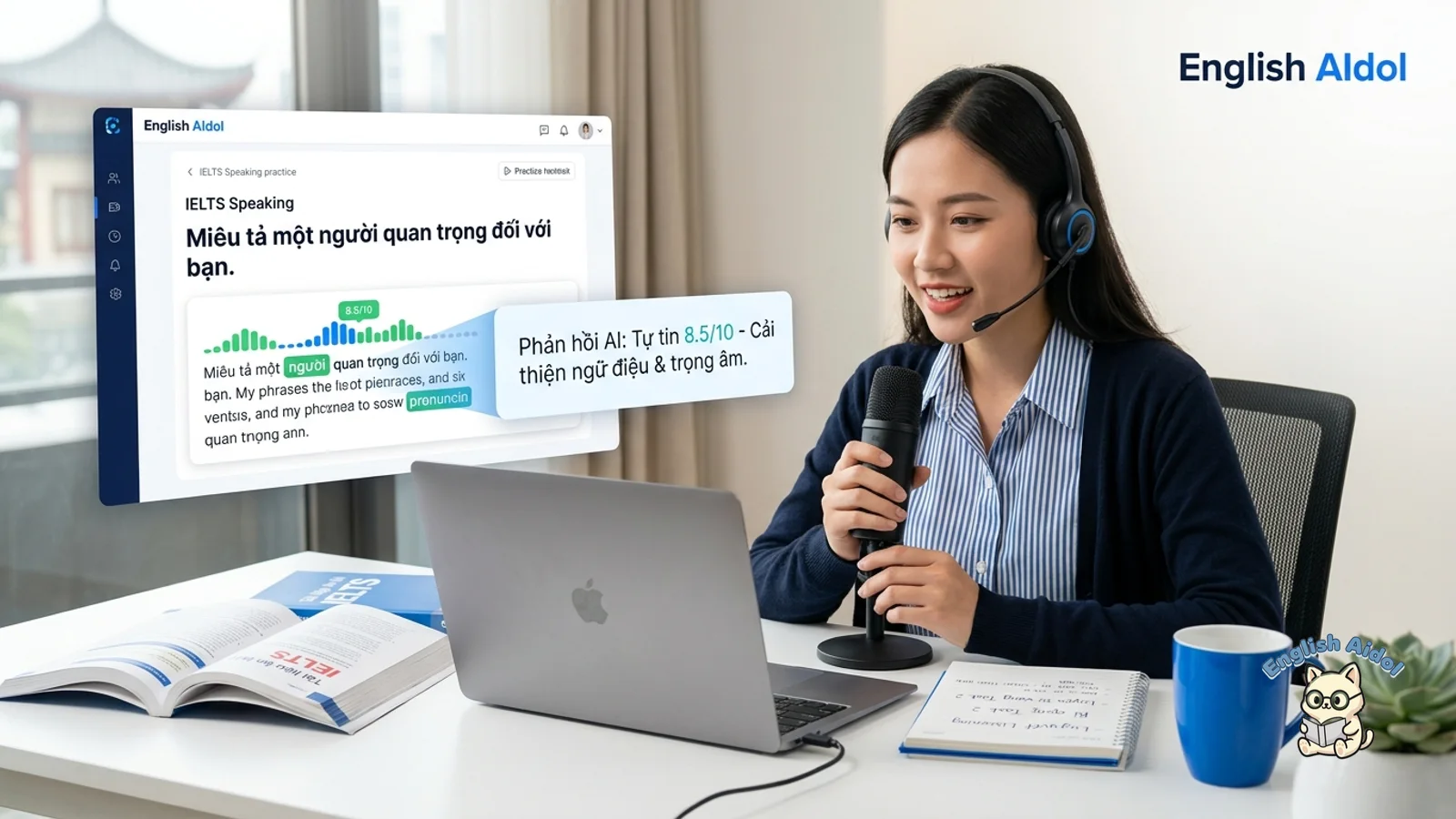
What this guide covers
Answer first
IELTS has four sections: Listening, Reading, Writing, and Speaking. English AIdol groups independent practice for all four skills; automated feedback and band estimates are unofficial study aids.
Official source: IELTS Academic test format in detail · Source checked · Published by English AIdol · Editorial and corrections policy
Start here
Use this IELTS portal when you need one clear starting point for Reading, Listening, Writing, and Speaking practice instead of opening four separate tools.
Free mini practice
Use these four short activities to find a useful starting skill. They are diagnostic prompts for study planning, not a band-score prediction.
How to try it: Try each item before reading its answer or self-check. For the listening preview, ask a partner or text-to-speech tool to read the line once while you look away.
1. Reading check
The college library will remain open until 10 p.m. during exam month. The help desk, however, will continue to close at 6 p.m.
Answer or self-check: B. Students may use the library after the help desk closes.
Why: The building stays open until 10 p.m., but “however” limits the help desk to 6 p.m. Option B preserves that contrast.
2. Listening preview
The seminar has moved from Room 204 to Room 402, but it will still begin at 2:15.
Answer or self-check: Room 402; 2:15.
Why: Room 204 is corrected, while the start time is explicitly unchanged. Listen for correction markers such as “moved” and “but”.
3. Writing plan
Answer or self-check: A strong plan states a clear overall judgement, gives two non-overlapping reasons, and leaves room to acknowledge one limitation. Either position can work if it answers “outweigh”.
Why: This planning check rewards a direct position and developed reasoning. It does not assess a full essay or produce an IELTS band.
4. Speaking prompt
Answer or self-check: Self-check: give the change in your first sentence, add one concrete before-and-after example, and connect the example to a result. Aim for a clear 45–60 second response.
Why: Specific sequencing makes an answer easier to follow and gives you evidence to review for fluency, vocabulary, grammar, and pronunciation.
Reading practice · Listening practice · Writing practice · Speaking practice
Practice access and feedback limits depend on the current activity and plan. Automated feedback and band estimates are unofficial study guidance.
Use the IELTS practice-test guide to choose a matched four-skill mock, confirm Academic versus General Training, and turn the result into a weekly plan. For a shorter session, open the Reading, Listening, Writing, or Speaking practice page directly.
Keep an evidence record after every attempt: answer locations for Reading, exact audio evidence for Listening, a revised response for Writing, and a recording plus targeted re-recording for Speaking.