IELTS guide
IELTS Speaking Practice for Parts 1, 2 and 3
Practise all three parts of IELTS Speaking and review AI feedback on fluency, pronunciation, vocabulary, and grammar. Any band shown is an unofficial practice estimate, not an examiner result.
IELTS guide
Practise all three parts of IELTS Speaking and review AI feedback on fluency, pronunciation, vocabulary, and grammar. Any band shown is an unofficial practice estimate, not an examiner result.
What this guide covers
Answer first
IELTS Speaking is a face-to-face interview with three parts lasting about 11–14 minutes. English AIdol provides original prompts and unofficial practice feedback.
Official source: IELTS Academic test format in detail · Source checked · Published by English AIdol · Editorial and corrections policy
Start here
Record IELTS Speaking Part 1, Part 2, or Part 3 answers, then review fluency, pronunciation, vocabulary, grammar, and answer development.
Free mini practice
Record one short response for each Speaking part, then review clarity, development, vocabulary, grammar, and pronunciation separately.
How to try it: Answer naturally rather than memorising the sample direction. Replay your recording once and note one strong feature and one specific revision target.
1. Part 1 — Familiar topic
Answer or self-check: Self-check: answer both “when” and “why”, then add one concrete detail such as your schedule, energy level, or study environment.
Why: A direct answer plus a relevant detail develops the response without turning a familiar-topic question into a memorised speech.
2. Part 2 — Long turn plan
Answer or self-check: Planning direction: identify the person and skill immediately, choose two chronological learning moments, and finish with one specific situation where the skill helped you.
Why: A simple sequence supports a sustained answer and ensures that every cue is covered with connected detail.
3. Part 3 — Discussion
Answer or self-check: Sample direction: Practical skills deserve more time when they complement core academic learning—for example, a budgeting project can apply mathematics—but schools should avoid replacing foundational knowledge with short-term job training.
Why: The response gives a position, a relevant example, and a qualification, which creates more analytical depth than a simple yes-or-no answer.
The IELTS Speaking test is a face-to-face interview with a trained examiner, lasting 11 to 14 minutes. It is the same for both Academic and General Training candidates. The test is divided into three distinct parts, each designed to assess different aspects of your spoken English ability. Understanding what each part requires — and what examiners are listening for — is essential for achieving your target band score.
Part 1 lasts 4-5 minutes and covers familiar topics about your life, interests, and daily routines. The examiner asks straightforward questions such as "Where are you from?", "Do you enjoy cooking?", or "How do you usually spend your weekends?" This part is designed to put you at ease and assess your ability to communicate about everyday topics. You should give responses of 2-4 sentences — not one-word answers, but not long monologues either.
Part 2 is the individual long turn. You receive a cue card with a topic and 3-4 bullet points to cover. You have one minute to prepare and make notes, then you must speak for 1-2 minutes without interruption. The examiner may ask one or two brief follow-up questions. This part tests your ability to speak at length on a topic, organize your thoughts, and use appropriate language. Part 3 follows with a 4-5 minute discussion exploring more abstract ideas related to the Part 2 topic, testing your ability to express and justify opinions, speculate, and discuss complex issues.
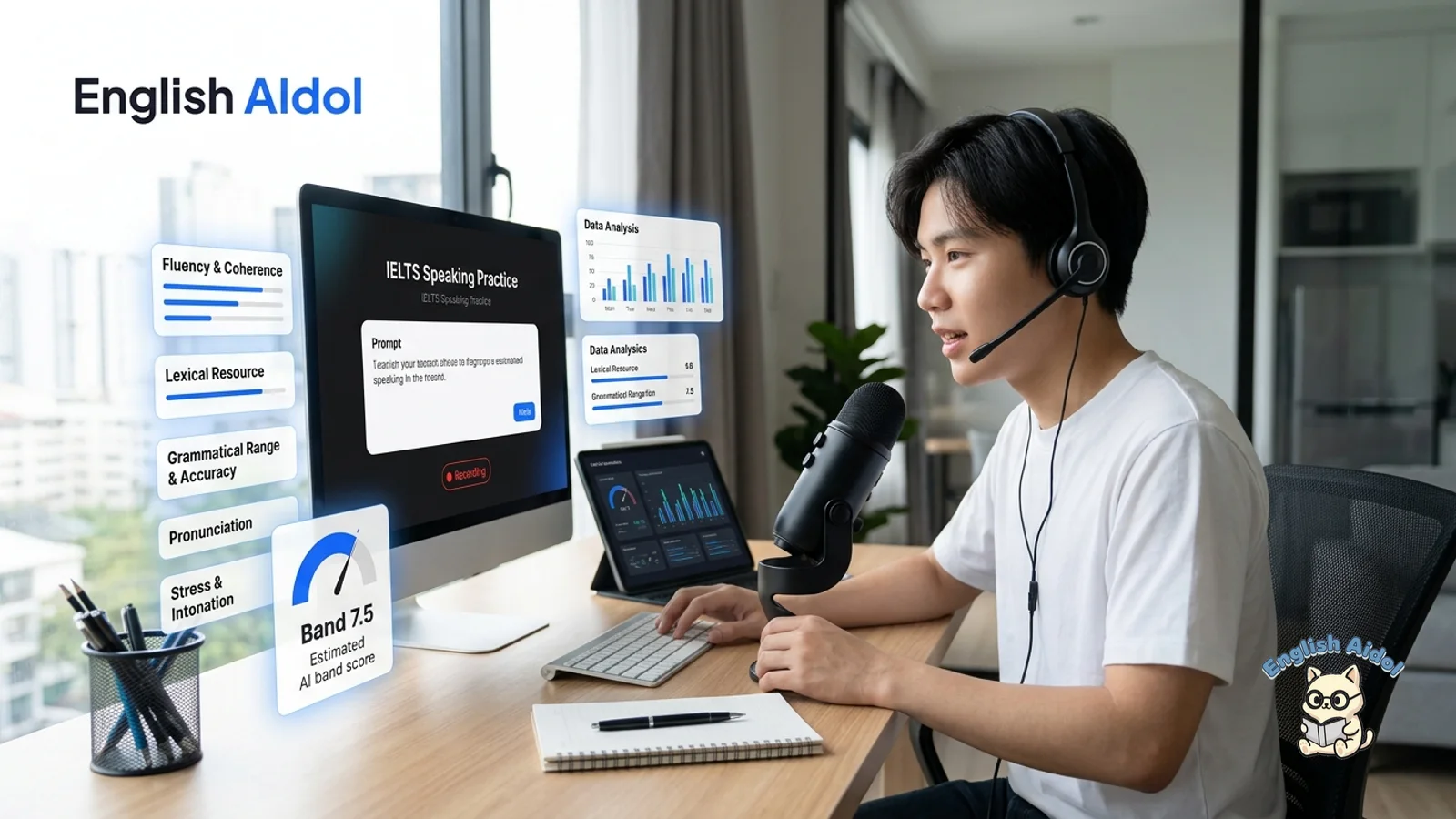
Speaking practice benefits from recording, review, and repetition. English AIdol can transcribe a response and generate feedback related to fluency, pronunciation, vocabulary, grammar, and task development.
Automated analysis can miss context, accents, audio problems, or natural variation. Treat every band as an unofficial estimate, check the evidence, and re-record with one targeted change. Use qualified human feedback when a high-stakes readiness decision requires professional judgement.
Availability, saved history, usage limits, and advanced feedback depend on the current product and plan. Check the live practice and pricing screens rather than assuming unlimited access.
Band 7 in IELTS Speaking requires fluency with only occasional hesitation, clear pronunciation with sustained use of natural speech features, a wide enough vocabulary to discuss topics flexibly, and frequent use of complex sentence structures with good control of grammar. Here are specific strategies for each scoring criterion.
For Fluency and Coherence, practice speaking at a natural pace without long pauses. If you need a moment to think, use discourse markers like "That's an interesting question," or "Let me think about that for a moment." Organize your responses with clear signposting: "The main reason is...", "Another factor is...", "On the other hand..." For Part 2, use your one minute of preparation time to write down 4-5 key words, not full sentences — these serve as a roadmap so you do not lose your train of thought during the two-minute talk.
For Pronunciation, focus on word stress, sentence stress, and intonation rather than trying to sound like a native speaker. The IELTS examiner is assessing whether you can be understood easily, not whether you have a particular accent. Practice recording yourself and listening back — most candidates are surprised by pronunciation habits they were not aware of. For Lexical Resource, learn topic-specific vocabulary and practice using idiomatic expressions naturally, not as memorized phrases. For Grammatical Range, consciously practice using conditional sentences ("If I had more time, I would..."), relative clauses ("The person who influenced me most..."), and a variety of tense forms in your speaking practice.
IELTS Speaking topics rotate but fall into predictable categories. Part 1 frequently covers work or studies, hometown, accommodation, hobbies, food, weather, transport, technology, and daily routines. Part 2 cue cards commonly ask you to describe a person, place, event, object, or experience. Part 3 questions explore related themes at a more abstract level — for example, if Part 2 asks about a book you enjoyed, Part 3 might ask about the role of reading in education or how technology has changed reading habits.
Practise speaking about varied topics rather than forcing one memorised answer onto a different question. Build a bank of real experiences, opinions, and examples that you can adapt naturally. This supports relevance and fluency, but no topic bank or AI tool can predict the live questions or guarantee a band.
Open a real IELTS Speaking topic page with prompt audio, recording, topic vocabulary, and AI feedback. These links also help Google discover the interactive practice pages from the main hub.
Part 1 covers familiar topics like hobbies and hometown (4–5 minutes). Part 2 is a long turn on a cue card topic — you get 1 minute to prepare and 2 minutes to speak. Part 3 is an in-depth discussion linked to Part 2 topics (4–5 minutes). All three parts are scored together for one Speaking band score.
You speak naturally into your microphone. The AI transcribes your response and gives a practice estimate plus feedback on fluency, pronunciation, vocabulary, and grammar. It is a study aid, not an official examiner result.
Your result depends on your starting level, practice quality, and test-day performance. Use regular recordings to expand vocabulary, improve sentence control, reduce avoidable hesitation, and monitor the direction of your estimated scores over time.
Practise describing people, places, objects, events, experiences, and activities. These broad themes build flexible language but do not predict an official cue card.
Saved history depends on the current practice flow, account state, retention settings, and plan. Check the live feature and privacy information before relying on permanent storage.
IELTS Speaking is a face-to-face interview with a human examiner, while the current TOEFL Speaking section is recorded on a computer and uses Listen and Repeat plus Take an Interview. The easier format depends on whether you prefer live conversation or short computer-delivered tasks.