Free AI IELTS Writing Practice — Task 1 & Task 2
Get instant AI-powered feedback on your IELTS essays. Practice Task 1 and Task 2 with detailed scoring across all four criteria. Trusted by IELTS students from Vietnam, China, Korea, Japan, the Middle East, and Latin America.
Understanding the IELTS Writing Test Format
The IELTS Academic Writing test has two tasks that must be completed in 60 minutes. Task 1 requires you to describe, summarise, or explain visual information — such as a bar chart, line graph, pie chart, table, process diagram, or map — in at least 150 words. You should spend approximately 20 minutes on Task 1. Task 2 asks you to write an essay in response to an argument, problem, or point of view in at least 250 words, and you should spend approximately 40 minutes on it.
Task 2 contributes twice as much to your final Writing band score as Task 1. This means that even if your Task 1 is strong, a weak Task 2 will significantly lower your overall Writing score. Many candidates make the mistake of spending too long on Task 1 and rushing Task 2 — this is one of the most common reasons for disappointing Writing scores.
Both tasks are scored on four criteria: Task Achievement (or Task Response for Task 2), Coherence and Cohesion, Lexical Resource, and Grammatical Range and Accuracy. Each criterion is equally weighted and scored on the 0-9 band scale. Understanding what examiners look for in each criterion is the foundation of effective IELTS Writing preparation.
How AI Feedback Transforms Your IELTS Writing Practice
The hardest part of improving your IELTS Writing is getting quality feedback. Human tutors are expensive and often unavailable when you want to practice. Friends and language exchange partners rarely have the expertise to evaluate your essays against official IELTS criteria. This feedback gap is exactly what AI IELTS writing practice solves.
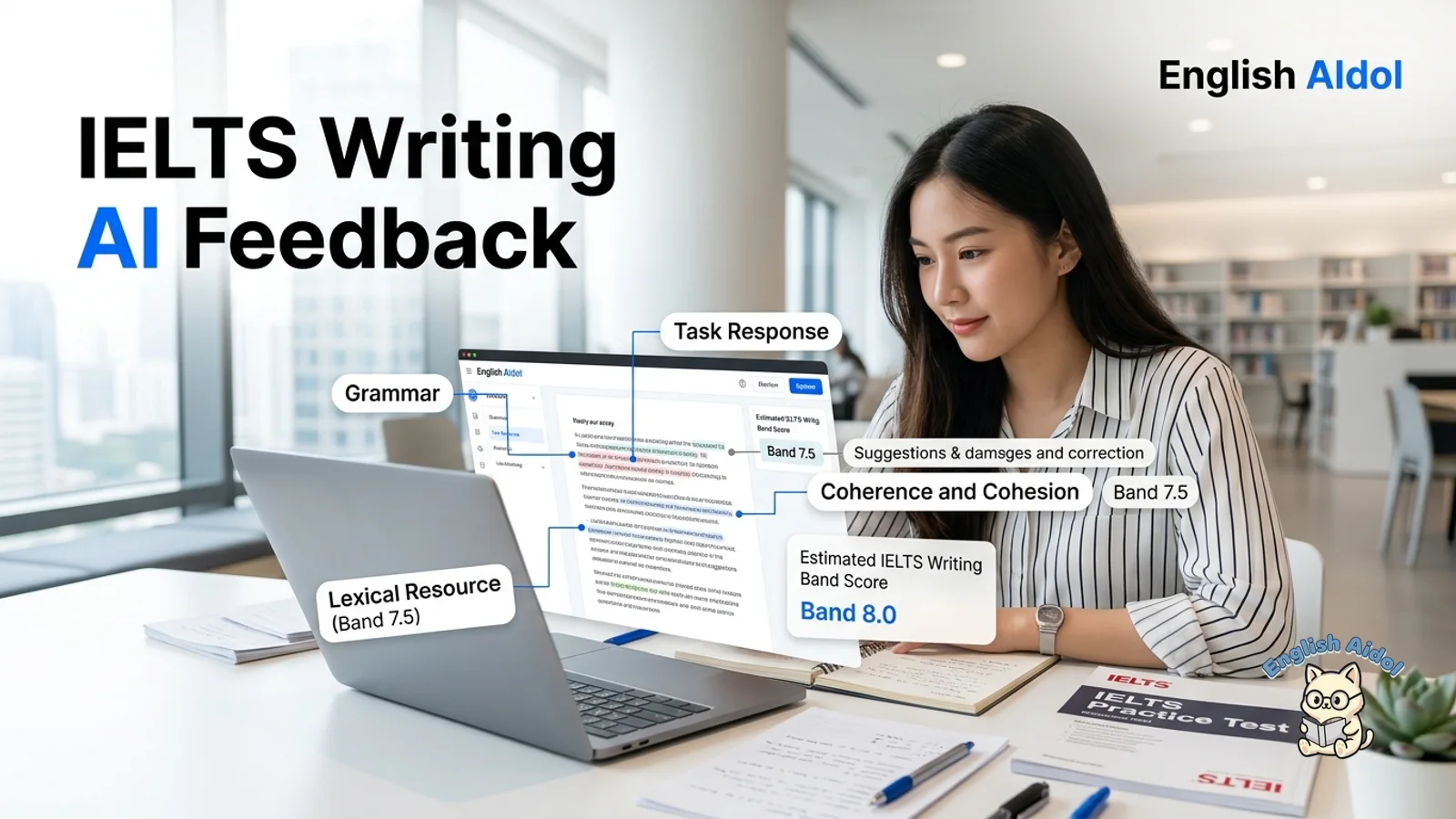
When you submit an essay on English AIdol, the AI evaluates your response against all four IELTS Writing criteria and provides a predicted band score for each. But the real value is in the detailed feedback: the AI identifies specific sentences where your grammar breaks down, highlights vocabulary that is too informal or repetitive, points out where your argument loses coherence, and suggests concrete improvements you can apply immediately.
Unlike a human tutor who might review one essay per week, the AI gives you feedback in seconds, allowing you to write multiple essays in a single study session and see your improvements in real time. Students who practice regularly with AI feedback typically improve by 0.5 to 1.0 band within four to six weeks. The AI also saves all your past essays so you can track your progress and see patterns in your mistakes over time.
Proven Strategies for Higher IELTS Writing Scores
For Task 2, always plan your essay before you start writing. Spend 3-5 minutes outlining your main arguments, supporting examples, and conclusion. A well-planned essay with clear paragraph structure will score higher on Coherence and Cohesion than a longer essay that rambles without direction. Use a four-paragraph structure: introduction, body paragraph 1, body paragraph 2, conclusion. Each body paragraph should have a clear topic sentence, supporting evidence, and an explanation of how the evidence connects to your main argument.
For Lexical Resource, avoid repeating the same words. If the question asks about "education," use synonyms and related terms: "learning," "schooling," "academic development," "knowledge acquisition." But do not force obscure vocabulary — examiners reward precise, natural word choice over artificially complex language. Collocations matter more than individual big words: "pose a significant challenge" is better than using a rarely-seen synonym.
For Grammatical Range and Accuracy, you need to demonstrate both complex structures and accuracy. Use a mix of simple, compound, and complex sentences. Include conditional sentences, relative clauses, passive voice where appropriate, and a variety of tense forms. However, accuracy is just as important as range — a simple sentence with no errors scores better than a complex sentence with multiple mistakes. Proofread your essay in the last 2-3 minutes and correct any errors you can spot.
Common IELTS Writing Task 2 Topics in 2026
IELTS Writing Task 2 topics recur in predictable categories. The most frequent themes include education (online learning vs classroom, education funding, university vs vocational training), technology (social media impact, artificial intelligence, screen time), environment (climate change, pollution, sustainability), health (public health spending, diet and exercise, mental health), society (urbanization, crime prevention, cultural diversity), and work (remote work, automation, work-life balance).
You do not need to be an expert on these topics, but you should have relevant vocabulary and example arguments prepared for each category. Practice writing at least one essay per topic category using English AIdol's AI feedback. This ensures you are never caught off guard by an unfamiliar topic on test day. The AI generates new prompts from the latest official IELTS question bank so your practice stays current and relevant.
Frequently Asked Questions
What are the two IELTS Writing tasks?
Task 1 requires describing visual data (graphs, charts, maps, or processes) in 150+ words in 20 minutes. Task 2 is an essay responding to an argument or opinion in 250+ words in 40 minutes. Task 2 carries more weight in your final band score.
How is IELTS Writing scored?
Writing is assessed on four criteria: Task Achievement/Response, Coherence and Cohesion, Lexical Resource, and Grammatical Range and Accuracy. Each criterion is scored 0-9 and averaged for the final band score. Task 2 is weighted more heavily than Task 1.
Can AI really help improve my IELTS Writing?
Yes! Our AI provides instant, detailed feedback on all four IELTS scoring criteria, highlights specific areas for improvement, suggests better vocabulary and grammar structures, and tracks your progress over time. Most students improve 0.5–1.0 band within 4–6 weeks of consistent practice.
What are the most common IELTS Writing Task 2 mistakes?
The most common mistakes are: not answering the question fully (Task Achievement), writing fewer than 250 words, poor paragraph structure, repeating the same vocabulary, and overly simple grammar. AI feedback on English AIdol identifies all of these in real time.
How often should I practice IELTS Writing?
Aim for at least 3–4 essays per week. Consistent practice with detailed AI feedback is the fastest path to improving your band score. Unlike writing classes, our AI gives instant feedback 24/7 so you can practice anytime.
What IELTS Writing score do I need for study abroad?
Most universities require an overall IELTS band of 6.5–7.0. For the Writing section specifically, many programs accept a minimum of 6.0–6.5. Top UK, Australian, and Canadian universities may require Writing band 7.0+. Check your target institution's requirements.