Free mini practice
Four-skill IELTS starter sampler
Use these four short activities to find a useful starting skill. They are diagnostic prompts for study planning, not a band-score prediction.
How to try it: Try each item before reading its answer or self-check. For the listening preview, ask a partner or text-to-speech tool to read the line once while you look away.
-
1. Reading check
The college library will remain open until 10 p.m. during exam month. The help desk, however, will continue to close at 6 p.m.
Which statement is supported by the notice?
- A. Every library service stays open until 10 p.m.
- B. Students may use the library after the help desk closes.
- C. The help desk closes later during exam month.
Answer or self-check: B. Students may use the library after the help desk closes.
Why: The building stays open until 10 p.m., but “however” limits the help desk to 6 p.m. Option B preserves that contrast.
-
2. Listening preview
The seminar has moved from Room 204 to Room 402, but it will still begin at 2:15.
Record the final room number and the start time.
Answer or self-check: Room 402; 2:15.
Why: Room 204 is corrected, while the start time is explicitly unchanged. Listen for correction markers such as “moved” and “but”.
-
3. Writing plan
Some universities record all lectures for students to watch later. Do the advantages outweigh the disadvantages? Write a one-sentence position and two distinct reasons.
Answer or self-check: A strong plan states a clear overall judgement, gives two non-overlapping reasons, and leaves room to acknowledge one limitation. Either position can work if it answers “outweigh”.
Why: This planning check rewards a direct position and developed reasoning. It does not assess a full essay or produce an IELTS band.
-
4. Speaking prompt
Describe one useful change you made to your study routine. Explain what you did, what was different before, and what result you noticed.
Answer or self-check: Self-check: give the change in your first sentence, add one concrete before-and-after example, and connect the example to a result. Aim for a clear 45–60 second response.
Why: Specific sequencing makes an answer easier to follow and gives you evidence to review for fluency, vocabulary, grammar, and pronunciation.
What This IELTS Portal Includes
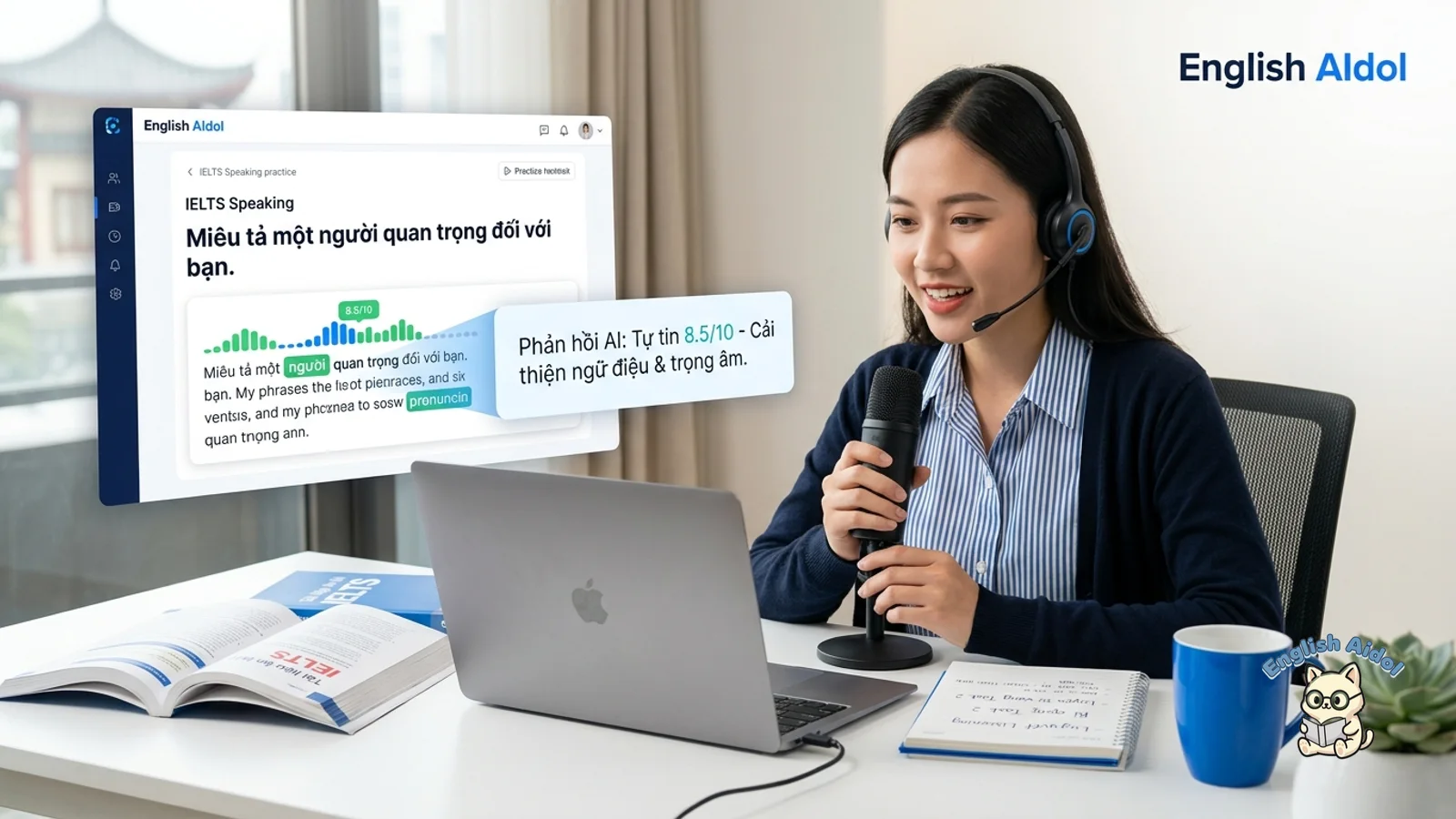
The English AIdol IELTS portal covers every component you need for complete IELTS preparation, in one place. (1) Diagnostic test — a full mock test across all four skills to establish your baseline band score. (2) Section practice — individual Reading, Listening, Writing, and Speaking tests organised by difficulty and question type. (3) AI-graded Writing feedback on Task 1 and Task 2 essays, scored against the four official criteria with sentence-level explanations. (4) AI-graded Speaking practice for all three Speaking parts with audio analysis covering Fluency, Pronunciation, Lexical Resource, and Grammar.
(5) Timed mock practice for pacing and review, with a clear statement that it is not identical to an official test. (6) Vocabulary and grammar review linked to recurring errors. (7) Suggested study priorities that you can check against your section requirements. (8) Progress tracking that separates unofficial estimates from official results.
How to Use This Portal Most Effectively
Step 1: Take the diagnostic test in week 1. Complete the full mock test across all four skills. Note your starting band in each. This baseline is the foundation of an effective study plan — without it, you cannot measure whether your practice is producing real improvement.
Step 2: Identify your weakest skill. Most candidates have one skill that is 1.0–1.5 bands below the others. Allocate 50–60% of your study time to that weakest skill. The fastest path to a higher overall band is lifting your lowest section, not balanced practice across all four.
Step 3: Build a daily practice rhythm. 30–60 minutes per day, five days per week, produces more improvement than 4-hour weekend marathons. Spaced practice strengthens retention; massed practice causes diminishing returns.
Step 4: Use AI feedback actively. After every AI-graded essay or speaking response, rewrite the weakest paragraph or re-record the weakest segment applying the AI suggestions. This active correction is what turns feedback into real skill improvement.
Step 5: Take 4–6 mock tests in the final 2 weeks. Individual skill practice does not build the endurance and time management needed for the 2 hour 45 minute exam. Full mock tests under exam conditions are essential preparation in the final stretch.
Why English AIdol vs Other IELTS Portals
Compare IELTS portals by current task coverage, criterion-level Writing and Speaking comments, answer explanations, access limits, privacy, and score disclaimers. English AIdol organises automated feedback around the published criteria, but it does not reproduce an examiner result.
Second, native-language interfaces — the portal supports Korean, Japanese, Vietnamese, Indonesian, Arabic, Chinese, and 6 more languages, with country-specific tips for common pronunciation and grammar challenges. Studying through your strong language while practicing your target language is significantly more effective than studying through a foreign-only interface.
Third, useful free practice — the basic portal does not require a credit card. Check the current plan page for practice limits and premium features.
Fourth, criterion-based AI feedback — Writing and Speaking feedback is organised around the published IELTS criteria. Predicted bands are practice estimates, not official IELTS scores, and can differ from a trained examiner's result.
Frequently Asked Questions
What IELTS skills can I practice on this portal?
English AIdol covers all four IELTS skills with AI-powered feedback: Reading (with AI explanations for every wrong answer), Writing Task 1 & 2 (criterion-level feedback against the four official criteria), Speaking Parts 1-3 (audio analysis with feedback on Fluency, Pronunciation, Lexical Resource, Grammar), and Listening (full tests with detailed answer explanations).
How accurate is the AI band score?
The AI band is a practice estimate based on your response and the published IELTS criteria. It can help you spot patterns across repeated attempts, but it is not an official score and may differ from a trained examiner.
Is the IELTS portal free?
Some portal practice may be available without payment, while task, submission, feedback, and progress limits depend on the current plan. Check the portal or pricing screen for live details.
Do I need to be at a certain English level to use the portal?
Learners can begin with shorter vocabulary, grammar, or skill activities before longer timed practice. Available difficulty and personalisation depend on the current activity; an automated diagnostic is an estimate, not a guarantee that every task adapts to your level.
What language interfaces are supported?
English, Korean (한국어), Japanese (日本語), Vietnamese (Tiếng Việt), Chinese (中文), Indonesian (Bahasa Indonesia), Arabic (العربية), Hindi (हिन्दी), Spanish (Español), Portuguese (Português), Turkish (Türkçe), and more. Each interface includes country-specific tips for common pronunciation and grammar challenges.
How long until I see improvement?
There is no guaranteed timeline. It depends on your starting level, target, practice quality, and how consistently you apply feedback. Track several timed attempts and revise weak responses before deciding whether your score is moving.