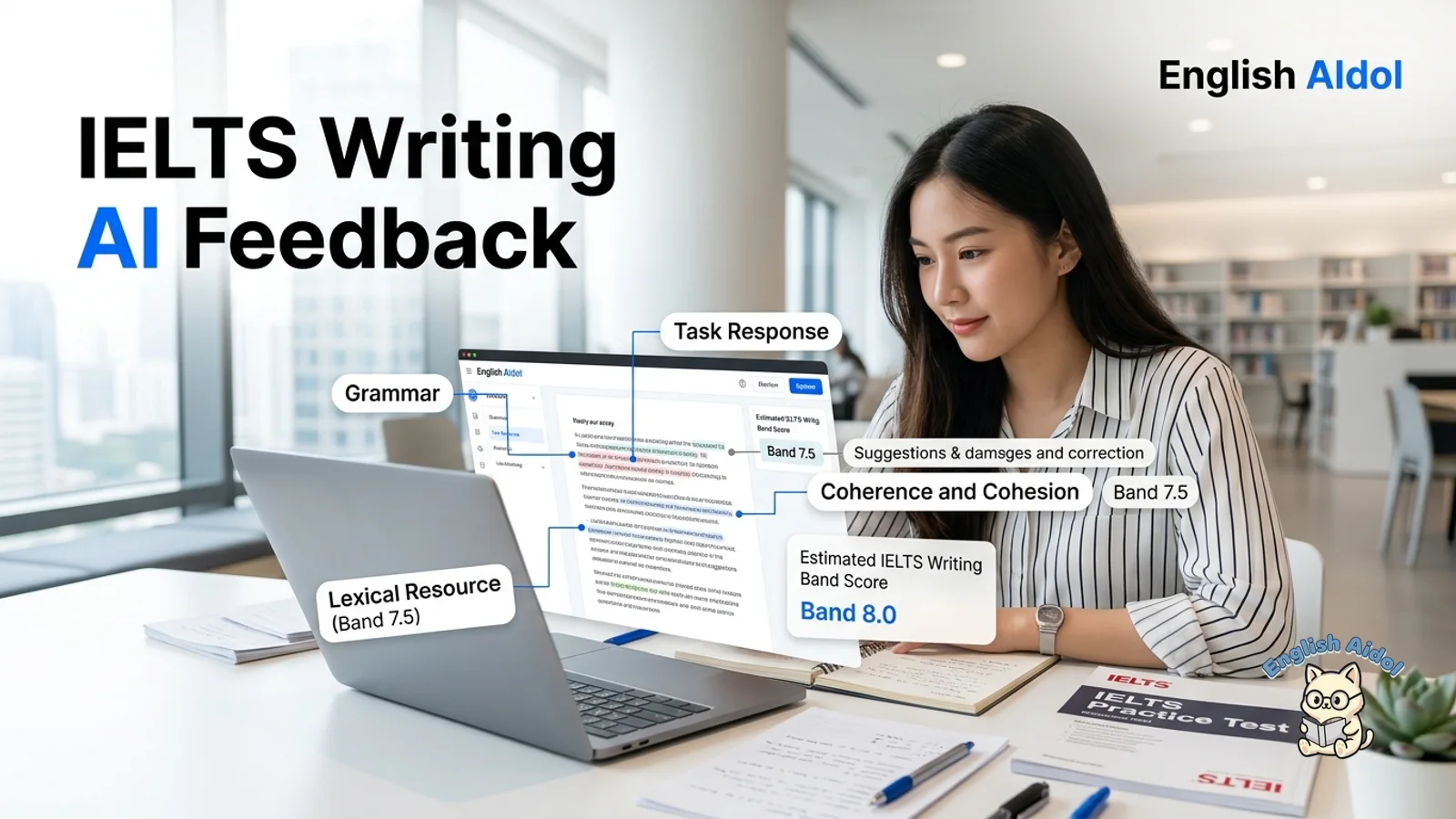
How the AI IELTS Writing Checker Works
Paste a Task 1 or Task 2 response into the checker to receive automated comments organised around Task Achievement or Task Response, Coherence and Cohesion, Lexical Resource, and Grammatical Range and Accuracy. Processing time and feedback detail vary, and every band shown is an unofficial estimate rather than the result of official examiner marking.
Beyond the band score, the AI gives sentence-level feedback. It highlights specific sentences where your grammar broke down, points out vocabulary that is too informal or too repetitive, identifies paragraphs that lose coherence, and shows you exactly where your argument structure could be tightened. This level of detail is what separates a useful AI writing checker from a generic grammar tool — you should always be able to see WHY you received a particular band, not just a black-box score.
What Makes a Reliable AI IELTS Writing Checker
Compare tools by criterion-level feedback, evidence tied to the submitted essay, transparent limitations, and any relevant published validation. Do not infer examiner calibration from marketing language; a provider making that claim should describe its evaluation set, human-rating process, uncertainty, and results.
Avoid checkers that give a single overall band without explanation or rely only on generic grammar correction. A useful practice tool should show which criterion each comment relates to and make its limitations clear.
How Accurate Is AI Writing Checking vs Human Examiners?
AI writing estimates can differ from human examiner scores, and the margin varies by tool and essay. Unless a tool publishes relevant validation evidence, do not assume a fixed accuracy range. Use the criterion feedback to revise, then confirm high-stakes readiness with official samples or qualified review.
Automated systems can handle topic relevance, unusual structures, vocabulary, and grammar differently. Inspect the criterion evidence, test suggestions in a revision, and do not generalise one tool's behaviour to every essay or model.
Tips to Get the Most from AI Writing Checking
Choose a sustainable practice rhythm. After receiving feedback, rewrite the weakest paragraph and compare it with the task directions. No fixed submission frequency guarantees faster improvement.
Track your work over time. Use saved essay history to compare recurring criterion weaknesses across several responses. Focus on the evidence in the feedback rather than assuming changes in an estimated band equal the same change on the official test.
Practice every question type. IELTS Task 2 has 5 main question types (Opinion, Discussion, Problem-Solution, Advantage-Disadvantage, Double Question) and IELTS Task 1 Academic has 7+ chart types. Submit at least one essay per type so you do not develop a blind spot for less common formats.
Use the AI feedback as a checklist. Before submitting your next essay, apply the most important corrections from your previous feedback. Rewriting makes the advice testable, but the size and speed of improvement vary.
How to Turn AI Feedback into a Higher Writing Band
Do not submit ten essays and only read the scores. Submit one essay, identify the weakest criterion, rewrite one paragraph, and compare the feedback. This is where score movement happens.
For Task 2, check whether your position is clear and your body paragraphs are developed. For Task 1, check whether the overview is specific and the key features are compared. Grammar and vocabulary matter, but Task Response and Coherence often decide whether an essay reaches band 7.
Frequently Asked Questions
Is the AI IELTS writing checker free?
Some checking may be available without payment, while submission limits and feedback depth depend on the current plan. Check the practice or pricing screen for live details.
How accurate is the AI IELTS writing checker?
It provides an unofficial practice estimate that can differ from a human examiner. Use the criterion evidence and trends across several essays, and confirm important decisions with official materials or qualified review.
Does the checker work for both Academic and General Training?
Yes — the AI IELTS writing checker grades both Academic Task 1 (visual descriptions: graphs, charts, processes, maps) and General Training Task 1 (letters: formal, semi-formal, informal), plus Task 2 essays which are similar in both versions.
How is the writing band score calculated?
Each of the four official Writing criteria (Task Achievement, Coherence & Cohesion, Lexical Resource, Grammatical Range & Accuracy) is scored 0–9. The four scores are averaged and rounded to the nearest 0.5 to produce your Writing band score. This matches the official IELTS scoring methodology.
Can the AI checker help improve my IELTS Writing?
It can help you identify issues and test revisions. Improvement is not guaranteed: apply the feedback by rewriting weak paragraphs, compare several timed essays, and seek qualified human review when you need a dependable readiness check.