How the AI IELTS Speaking Test Relates to the Real Exam
The real IELTS Speaking test is a face-to-face interview with a trained examiner and lasts 11–14 minutes. Independent practice can follow Parts 1, 2, and 3 and their published timing, but it cannot replicate examiner interaction or guarantee the exact live experience.
Recorded practice may provide transcription, pacing, hesitation, pronunciation, grammar, or vocabulary feedback. Available signals and processing time vary, and the resulting band is an unofficial estimate that may miss nuance or audio context.
What the AI Examiner Listens For
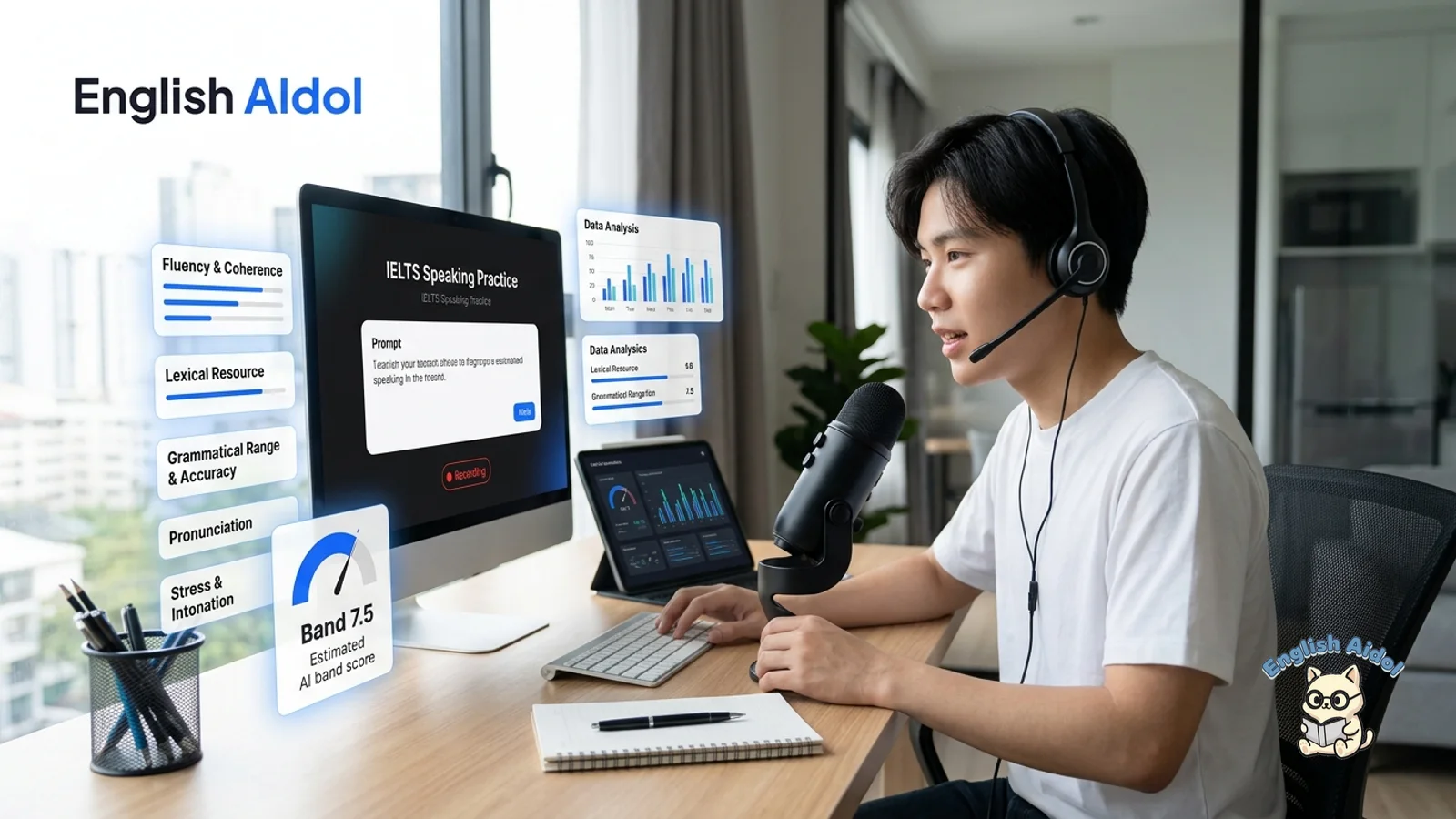
Fluency and Coherence: review pace, hesitation, repetition, self-correction, and how clearly ideas connect. Automated measurements are proxies and should be checked against the published descriptor and the recording itself.
Lexical Resource: the AI evaluates the range and accuracy of your vocabulary. It looks for topic-specific words, idiomatic expressions used naturally (not as memorised phrases), and the ability to paraphrase when you do not know the exact word. Repetition of basic vocabulary lowers your score.
Grammatical Range and Accuracy: the AI tracks the variety of sentence structures you use (simple, compound, complex, conditional, relative clauses, passive voice) and the proportion of error-free sentences. Band 7+ requires frequent use of complex structures with good control.
Pronunciation: the AI evaluates clarity and intelligibility, not accent. It looks for word stress, sentence stress, intonation patterns, and whether your pronunciation is consistently understandable to a non-specialist listener.
How Recorded Feedback Can Support Solo Practice
Reading questions alone does not create a speaking sample to review. Recording a response lets you inspect pace, clarity, language, and development, while a qualified partner or teacher can add interaction and nuanced judgement that automated feedback may miss.
The AI IELTS Speaking test provides prompts, records your response, and returns criterion-based practice feedback without scheduling a partner. It does not reproduce every judgement or interaction of a human examiner, and an AI score trajectory is not proof of an official band gain.
How to Make AI Speaking Tests Most Effective
Treat each test as a real exam. Find a quiet space, set up your microphone, and complete all three parts in one sitting. Do not pause to look up vocabulary or restart questions — the goal is to practice spontaneous speaking under exam conditions.
Record AND review. The AI saves your audio after each test. Listen back to your responses immediately after seeing the AI feedback. This is the most powerful learning step — you hear your own hesitations, mispronunciations, and grammar errors in context.
Re-record weak responses. After getting feedback on a Part 2 cue card or Part 3 question, re-record the same response immediately, deliberately applying the AI suggestions. This active correction is what builds new speaking habits.
Practice all topic areas. The AI rotates through the major IELTS Speaking topic areas: work and study, hometown and travel, technology, hobbies, health, society, environment, media. Make sure you practice every category so you are not surprised on test day.
Frequently Asked Questions
Is the AI IELTS Speaking test free?
Some speaking practice may be available without payment, while attempt and feedback limits depend on the current plan. Check the practice or pricing screen.
How long does the AI Speaking test take?
The official Speaking interview lasts 11–14 minutes. Independent practice duration depends on the included prompts and settings; following the three-part timing does not make it an official simulation.
How accurate is AI Speaking scoring?
AI Speaking scores are unofficial estimates and can differ from a trained examiner, especially for pronunciation, interaction, and nuanced language use. Use the detailed feedback across repeated recordings and confirm readiness with qualified review when possible.
Do I need any special equipment for the AI Speaking test?
You need a supported device and a working microphone. Browser permissions, background noise, connection quality, and device compatibility can affect recording and feedback.
How is recorded AI Speaking practice different from text chat?
A speech-enabled tool can analyse or transcribe audio signals that a text-only interaction does not contain. Exact pronunciation, fluency, grammar, and vocabulary coverage depends on the tool and remains unofficial.