The Complete IELTS Speaking Guide (2026)
Related guides:
Who This Guide Is For & What You'll Learn
This guide is for anyone preparing for the IELTS Academic or General Training Speaking test. It’s especially useful for first-time test-takers and those aiming to move from Band 6.5 to 7+. You will learn the exact test format, how scoring works, the most common mistakes, and specific strategies for each part. We'll demystify the band descriptors and show you how to practice effectively.
Table of Contents
- IELTS Speaking Test Format 2026
- The 4 IELTS Speaking Band Descriptors Explained
- Part 1: Introduction & Interview (4-5 Minutes)
- Part 2: The Long Turn / Cue Card (3-4 Minutes)
- Part 3: Two-Way Discussion (4-5 Minutes)
- IELTS Speaking Scoring: How Your Band Score is Calculated
- Top 5 Mistakes That Keep You at Band 6.5
- How to Use Cue Card Banks & Quarterly Forecasts
- Effective Practice Strategies & Recording Yourself
- Test Day: What to Expect at the Test Center
- Resources & Next Steps
IELTS Speaking Test Format 2026 {#format}
The IELTS Speaking test is a short, structured interview. It is the same for both Academic and General Training tests. The total time is 11 to 14 minutes, and it is recorded for quality assurance.
Key Facts:
- Duration: 11-14 minutes
- Parts: 3 (Part 1, Part 2, Part 3)
- Examiner: One certified IELTS examiner
- Recording: The test is always audio-recorded
- Scoring: You receive a band score from 1 to 9, in half-band increments (e.g., 6.5, 7.0).
The 4 IELTS Speaking Band Descriptors Explained {#descriptors}
Cambridge Assessment English scores you on four criteria, each weighted equally (25%). Understanding these is the key to targeted improvement.
- Fluency and Coherence (FC): This is about speaking at a normal speed without excessive pausing, self-correction, or repetition. Coherence means your ideas are logically connected and easy to follow. Using linking words (however, furthermore, on the other hand) effectively is part of this.
- Lexical Resource (LR): This assesses your vocabulary range, precision, and ability to use less common or idiomatic language appropriately. It's not about using "big" words incorrectly, but about having the right word for the situation.
- Grammatical Range and Accuracy (GRA): This criterion looks at the variety of sentence structures you use (simple, compound, complex) and how many errors you make. AI analysis shows that consistent small errors in tense and articles are the primary grammar issue for 70% of candidates scoring 6.5.
- Pronunciation (P): This is about how clearly you speak. It includes individual sounds, word stress, sentence stress, and intonation. The examiner must be able to understand you easily. A monotone voice can limit your score here.
Part 1: Introduction & Interview (4-5 Minutes) {#part1}
Part 1 is the warm-up. The examiner will introduce themselves, confirm your identity, and ask you general questions about familiar topics like your home, work, studies, hobbies, and family.
Strategy: Give full answers, not just one word. Aim for 2-3 sentences. For example:
- Question: "Do you like listening to music?"
- Weak Answer: "Yes, I do."
- Strong Answer: "Yes, absolutely. I'm particularly fond of jazz because I find it relaxing, and I often listen to it while I'm studying or cooking."
Part 2: The Long Turn / Cue Card (3-4 Minutes) {#part2}
You will be given a task card (cue card) with a topic and 3-4 bullet points. You have 1 minute to prepare and make notes, then you must speak for 1-2 minutes. The examiner may ask one or two follow-up questions.
Sample Cue Card Topic: Describe a useful website you have used. You should say: - what the website is - how you found it - what information it provides - and explain why you think it is useful.
Strategy: Use the 1-minute preparation wisely. Write down keywords for each bullet point, not full sentences. Structure your talk by following the bullet points in order. Try to speak for the full 2 minutes.
Part 3: Two-Way Discussion (4-5 Minutes) {#part3}
This part is a deeper discussion connected to the theme from Part 2. The questions are more abstract, asking for opinions, analysis, and speculation about broader issues.
Example: If Part 2 was about a website, Part 3 might discuss:
- "How has the internet changed the way people find information?"
- "Do you think all information on the internet is reliable?"
- "What might be the future of traditional libraries?"
Strategy: This is your chance to show your language ability. Develop your ideas. Give an opinion, provide a reason, and give an example. Use a range of grammatical structures to compare, speculate, and discuss hypothetical situations.
IELTS Speaking Scoring: How Your� Band Score is Calculated {#scoring}
Your final band score is the average of the four criteria scores (FC, LR, GRA, P). The scores are not rounded down; they follow strict mathematical rounding rules.
- Example: FC: 7, LR: 6.5, GRA: 6, P: 7. The average is (7+6.5+6+7)/4 = 6.625, which rounds up to Band 6.5.
- Example: FC: 7, LR: 7, GRA: 6.5, P: 7. The average is (7+7+6.5+7)/4 = 6.875, which rounds up to Band 7.
Top 5 Mistakes That Keep You at Band 6.5 {#mistakes}
Based on our AI analysis of thousands of practice tests, these are the most common barriers to Band 7.
- Memorized Answers: Examiners are trained to spot them. Your fluency will sound unnatural, and you'll struggle if the question is slightly different.
- Overly Simple Grammar: Using only simple sentences (Subject + Verb + Object) limits your GRA score. You must demonstrate complex structures (e.g., conditionals, relative clauses).
- Inconsistent Tense Use: Mixing past and present tense when telling a story is a major accuracy error flagged in 65% of Band 6.5 performances.
- Unnatural Vocabulary: Forcing in "advanced" words you don't fully understand sounds awkward and hurts your LR score. Precision is better than complexity.
- Flat Pronunciation: Speaking in a monotone, without stress or intonation, makes you harder to understand and limits your Pronunciation score, even if your sounds are clear.
How to Use Cue Card Banks & Quarterly Forecasts {#cuecards}
Cue card banks are lists of topics that have appeared in recent tests. Quarterly forecasts are predictions of which topics are likely to appear in the coming months.
How to use them effectively:
- Don't memorize. Use them to practice brainstorming ideas and vocabulary for a wide range of topics.
- Group similar topics. For example, "describe a person," "describe a teacher," and "describe a family member" can use similar descriptive language.
- Practice the 1-minute note-taking technique with different cards to build speed.
- Remember, the bullet points on the card are your structure guide. Always use them.
Effective Practice Strategies & Recording Yourself {#practice}
Passive study doesn't work for speaking. You must speak aloud.
- Record Yourself: Use your phone. Answer a Part 2 cue card, then listen back. Be your own examiner—check for pauses, repetition, grammar errors, and clarity.
- Mirror Practice: Talk to yourself in the mirror to get used to making eye contact and using natural facial expressions.
- Find a Speaking Partner: Practice Parts 1 and 3 with a friend or tutor who can ask follow-up questions.
- Shadowing: Listen to a high-level English speaker (e.g., a TED Talk) and repeat immediately after them, copying their rhythm and intonation.
Test Day: What to Expect at the Test Center {#testday}
- Bring the same ID you used for registration.
- The test may be on the same day as the other papers or on a different day.
- You will be taken to a quiet room with just the examiner.
- The examiner will start the recorder and begin Part 1.
- Speak clearly and at a natural volume. It's okay to ask the examiner to repeat a question if you don't understand ("Could you repeat the question, please?").
- Be prepared to talk about yourself and your opinions.
Resources & Next Steps {#nextsteps}
Now that you understand the test, it's time for focused practice.
- Download the official IELTS Speaking band descriptors from the IELTS website. This is your rubric.
- Start a vocabulary journal for common topics (education, environment, technology).
- Commit to 15 minutes of speaking practice every day. Consistency is key.
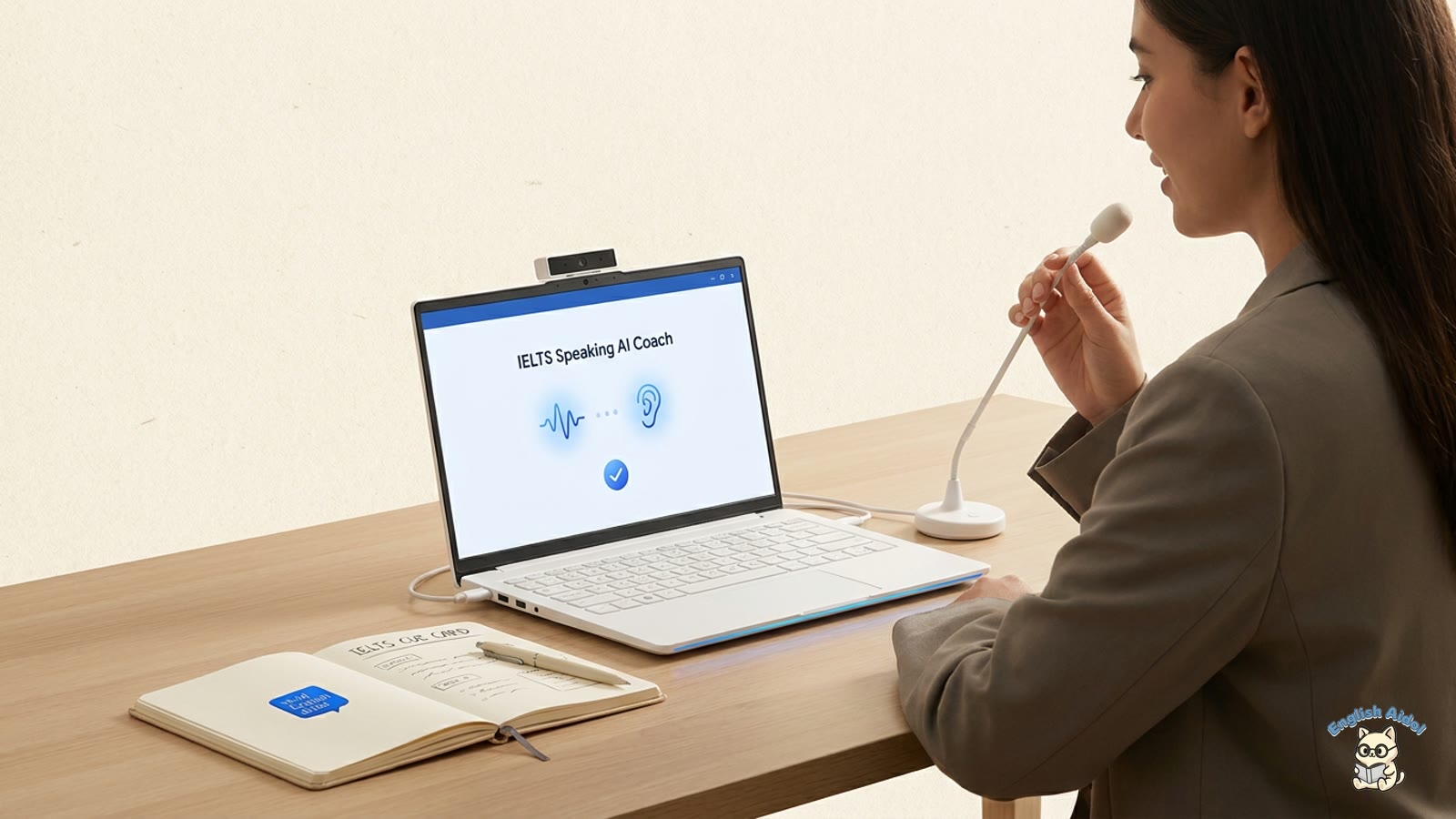
- Consider professional feedback. Our AI-powered platform, English AIdol, can analyze your practice responses, pinpoint errors, and show you exactly where you stand on the band scale.
- Explore our detailed child guides linked below for deep dives into each part and criterion.
Frequently Asked Questions (FAQs)
Q: Is the IELTS Speaking test face-to-face or on a computer? A: For most test-takers, it is a face-to-face interview with a certified examiner. However, if you take the IELTS on Computer test, the Speaking test is still face-to-face with an examiner; it is not done with a computer.
Q: Can I ask the examiner to repeat the question? A: Yes, you can. It is better to ask for clarification than to give an irrelevant answer. You can say, "I'm sorry, could you repeat the question, please?" or "Could you explain what you mean by...?"
Q: What if I don't know anything about the topic in Part 2? A: The topics are designed to be accessible to everyone. If you get a topic you're unfamiliar with, use the 1-minute preparation to think of a related experience or something you've read about. It's a test of your English, not your knowledge. You can say, "I haven't experienced this personally, but I know that..."
Q: How important is my accent for the Pronunciation score? A: Your native accent is not penalized. The Pronunciation score is based on how clearly you speak—your individual sounds, stress, rhythm, and intonation. The examiner must be able to understand you easily.
Q: Should I use British or American English? A: Both are perfectly acceptable. The IELTS is an international test. Use the variety of English you are most comfortable and consistent with. Don't mix accents or spelling within your response.
Q: What's the difference between Band 6 and Band 7 for Fluency? A: According to the official descriptors, a Band 6 speaker may "be willing to speak at length," but has noticeable hesitation and repetition. A Band 7 speaker speaks "at length without noticeable effort or loss of coherence." The flow is more natural.
Q: Can I correct myself if I make a grammar mistake? A: Yes, a quick, natural self-correction is fine and shows awareness. However, frequent self-correction that disrupts your fluency will negatively impact your Fluency score.
Q: How long should my answer be in Part 1? A: Aim for 2-3 sentences. Give a direct answer and add one piece of relevant detail or explanation. Avoid one-word answers, but also don't give a speech.
Explore This Topic Cluster