How long is the IELTS Speaking test?
11-14 minutes total. Part 1 (4-5 min) + Part 2 (3-4 min with 1 min prep) + Part 3 (4-5 min).
What happens in Speaking Part 1?
Examiner asks 10-12 short questions across 2-3 topics (Home, Work/Study, Free Time, etc.). Answer in 2-4 sentences each.
What happens in Part 2?
You receive a cue card with a topic, 1 minute to prepare, then speak 1-2 minutes on that topic. Cover all 4 bullet points.
What happens in Part 3?
Examiner asks 4-6 abstract discussion questions related to Part 2 topic. Answer in 4-6 developed sentences each.
Can I ask the examiner to repeat a question?
Yes — once or twice per part. Frequent repetition suggests poor listening and reduces your score.
What if I don''t understand a word?
You can ask: "Could you explain what X means?" Some words might be refused if central to the question.
Can I use British or American English?
Either. Consistency matters — don''t mix in one session.
Is it bad to use "um" and "uh"?
Occasional fillers are natural. More than 3-4 per answer drops fluency score.
Can I pause to think?
Short pauses OK. Long silences (5+ seconds) signal hesitation and drop fluency.
Can I use memorized answers?
NO — examiners detect memorized answers in seconds. Drops your Lexical Resource + Fluency score by 0.5-1 band.
What if I go blank in Part 2?
Use stall phrases: "Let me think about that for a moment..." Buy 3-5 seconds while you recover.
How do I pronounce words I don''t know?
Use context: sound it out phonetically. Don''t let one word stop you. Substitute with synonyms if needed.
Does my accent matter?
No — examiners don''t penalize accent. They penalize unintelligibility. A strong accent is fine if listeners understand you.
What accent should I aim for?
Your own, but clear. Don''t try to fake British or American.
Can I ask the examiner for their opinion?
No — Speaking test is one-way. Stay focused on your answers.
Is Speaking test recorded?
Yes — recordings are reviewed by senior examiner if EOR requested.
Where does the Speaking test happen?
Usually at the same test centre, separately scheduled — often same day afternoon or different day.
Can I fake experiences in Part 2?
Yes — examiners don''t care about truth, only language quality.
Do Part 1 topics repeat across tests?
Yes — pool of ~55 topics rotates every 4 months. Common ones: Home, Work, Free Time, Technology.
How do I improve Part 3?
Use OREC framework: Opinion + Reason + Example + Consequence. 4-6 sentences per answer.
Is Part 1 or Part 3 more important?
Equal weight on band calculation. Part 3 is harder because abstract topics require more complex grammar.
What''s a Band 7 Speaking response like?
Speaks at length without noticeable effort, some less-common vocabulary, complex grammar with frequent error-free sentences, wide pronunciation range.
What counts as complex grammar?
Relative clauses, conditionals, passive voice, reported speech, inversions.
Should I use idioms?
2-3 per Part 2/3 natural usage helps. Forced idioms hurt — examiners detect memorized phrases.
Can I bring water?
Yes — clear bottle with no label.
Can I bring my phone?
No phones at the test desk. Locker for belongings.
What should I wear?
Comfortable, formal-ish. First impression matters — smart casual works.
Can I use notes during Speaking?
Only in Part 2 (1-minute prep). Notes are on scratch paper provided; you return them at the end.
Can I look at the examiner?
Yes — natural eye contact is expected. Don''t stare at a fixed point.
What''s the "worst" thing I can do?
Reciting memorized answers. Examiners stop grading and penalize heavily.
Can I speak too much?
Yes in Part 1 — 60+ second answers are too long. Keep Part 1 to 15-25 seconds each.
What if the examiner interrupts me?
Normal — they manage timing. Don''t take it personally; continue when they ask next.
Do I need to use "complex vocabulary"?
Natural, precise vocabulary beats "complex" for its own sake. "Pivotal moment" > "incredibly awesome moment."
How long should Part 2 speech be?
90-120 seconds. Under 90 = too short; over 2 minutes = examiner cuts you off.
Can I use fillers like "you know, kind of, basically"?
1-2 per Part 2/3 is natural. Overuse (5+) kills fluency score.
Can the examiner change my mind about a topic?
No — Part 3 is discussion, not debate. Examiner probes your reasoning, doesn''t argue.
Does the examiner help if I''m nervous?
Somewhat — they''ll smile and nod. But they don''t coach or give hints.
What if I say the wrong thing?
Self-correct briefly: "Sorry, I meant..." Don''t restart whole sentences.
Can I laugh or joke?
Natural humor is fine. Excessive nervousness-laughter isn''t penalized but can disrupt fluency.
How do I prepare for Part 2 topics I''ve never thought about?
Use POWER framework (Place + Origin + Why it matters + Experience + Reflection). Works for any topic.
Can I use "always" or "never" in answers?
Yes but carefully. Absolutes ("everyone thinks") sound less sophisticated than "most people tend to believe."
What tense for Part 3 hypotheticals?
Second conditional: "If X happened, Y would occur." Speculation modals: might, could, would probably.
Can I give a very long Part 1 answer?
No — Part 1 expects 2-4 sentences (15-25 sec). Too long signals misreading the format.
Is Speaking easier after 2 minutes?
Usually yes — nerves reduce after Part 1. Practice helps this feel natural.
Can I talk about my job if I''m a student?
Yes in Part 1 ("Do you work or study?"). If you only study, say so — no penalty.
What if I can''t understand the examiner''s accent?
Examiners use neutral accents for fairness. Ask for repetition if needed.
Is IELTS Speaking online different?
IELTS Online Speaking uses video call with live examiner. Same questions, same criteria.
Can I practice Speaking alone?
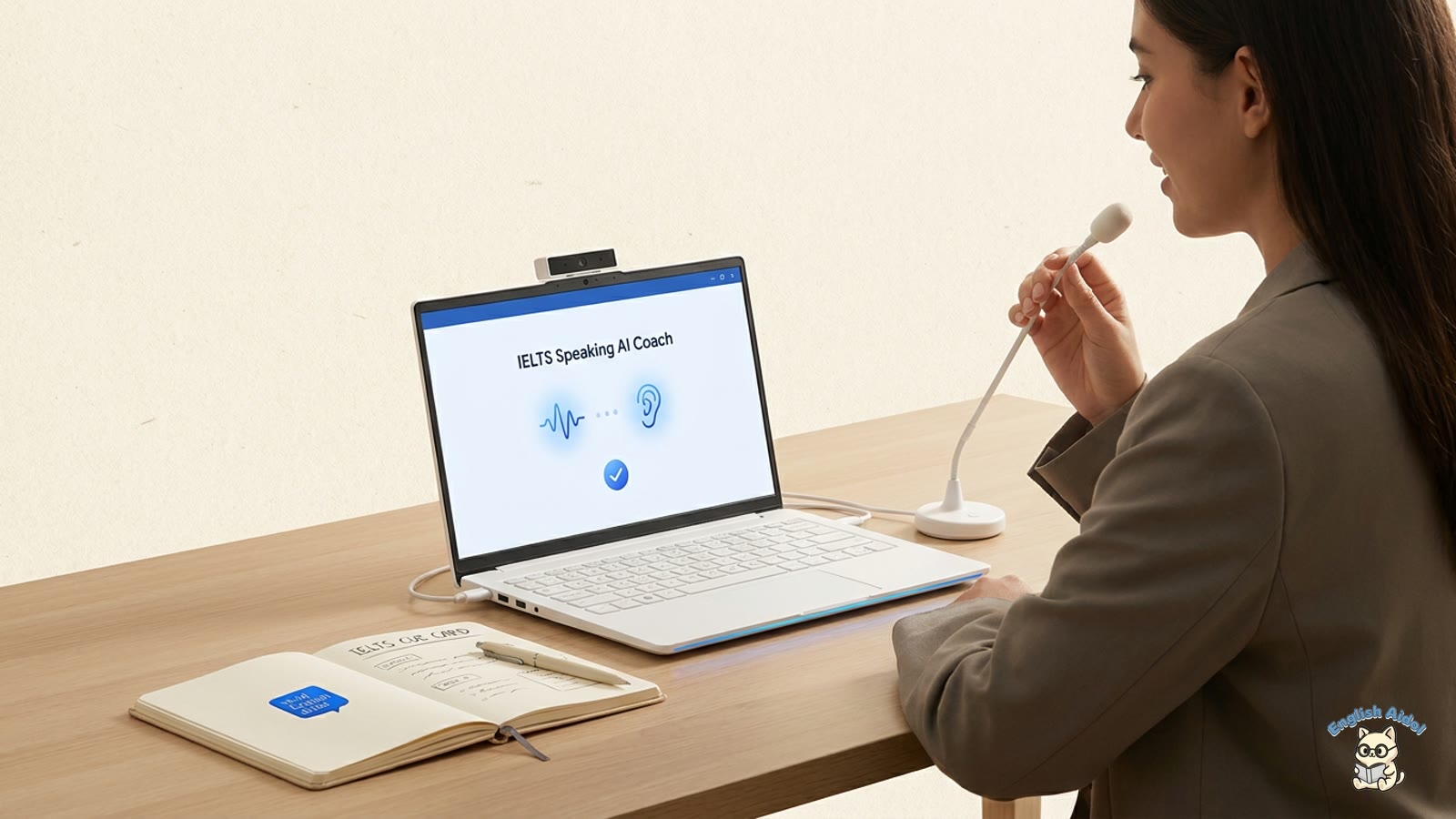
Yes — record yourself answering cue cards, listen back, fix errors. AI speaking partners (English AIdol) simulate examiner experience.
What''s the most common Part 2 topic?
"Describe a person who..." and "Describe a place/time when..." make up ~40% of topics.
Start Free Speaking Mock
Full Speaking mock with Band scores: Start free Speaking mock →