IELTS Speaking Part 1: Social Media — Questions & Band 7/8/9 Answers
Related guides:
Common IELTS Speaking Part 1 Social Media Questions
- How often do you use social media?
- What kind of social media do you use?
- What are the benefits of using social media?
- What are the drawbacks of using social media?
- Do you think social media is important for communication?
- How has social media changed the way people communicate?
- Do you think social media is addictive?
- How do you manage your time on social media?
Sample Answers
Band 6.0 Answer
Examiner: How often do you use social media?
Well, I use social media, like, every day. I check my phone, you know, when I wake up and before I sleep. It's just habit now. I use it for, like, an hour or two each day, maybe more on weekends. It's hard to, like, not use it, you know?
Scoring Breakdown
- TR (Task Response): 5.0 - Addresses the question but with limited detail and relevance.
- CC (Coherence and Cohesion): 5.0 - Ideas are somewhat organized but with frequent repetition and lack of logical sequencing.
- LR (Lexical Resource): 5.0 - Limited range of vocabulary with some inappropriate word choices and collocations.
- GRA (Grammatical Range and Accuracy): 5.0 - Frequent errors in grammar and sentence structure, with some basic sentence forms.
Band 7.0 Answer
Examiner: What kind of social media do you use?
I primarily use Instagram and LinkedIn. Instagram is great for staying connected with friends and family, sharing photos, and discovering new trends. LinkedIn, on the other hand, is more professional. I use it to network with colleagues, find job opportunities, and stay updated on industry news. I also occasionally use Twitter for quick updates and news.
Scoring Breakdown
- TR (Task Response): 7.0 - Addresses the question fully with relevant details and examples.
- CC (Coherence and Cohesion): 7.0 - Ideas are logically organized with clear progression and some use of cohesive devices.
- LR (Lexical Resource): 7.0 - Adequate range of vocabulary with some less common lexis and some minor errors in collocations.
- GRA (Grammatical Range and Accuracy): 7.0 - Uses a mix of simple and complex sentence forms with some errors in tense and agreement.
Band 8.0 Answer
Examiner: What are the benefits of using social media?
Social media offers numerous advantages. Firstly, it facilitates instant communication, allowing us to connect with people worldwide effortlessly. It also serves as a platform for self-expression and creativity, enabling users to share their thoughts, ideas, and talents. Additionally, social media provides access to a wealth of information and resources, making it an invaluable tool for learning and professional development. It fosters communities and support networks, particularly for those with shared interests or challenges.
Scoring Breakdown
- TR (Task Response): 8.0 - Addresses the question fully with detailed, relevant, and extended responses.
- CC (Coherence and Cohesion): 8.0 - Ideas are logically organized with clear progression and effective use of cohesive devices.
- LR (Lexical Resource): 8.0 - Adequate range of vocabulary with some less common lexis and some minor errors in collocations.
- GRA (Grammatical Range and Accuracy): 8.0 - Uses a mix of simple and complex sentence forms with some errors in tense and agreement.
Band 9.0 Answer
Examiner: How has social media changed the way people communicate?
Social media has revolutionized communication by making it instantaneous and global. It has transcended geographical boundaries, enabling real-time interactions with people across the world. The brevity and immediacy of platforms like Twitter have transformed how we share and consume information, often prioritizing concise, impactful messages. Moreover, social media has introduced new forms of expression, such as emojis and memes, which convey emotions and ideas succinctly. However, this shift has also led to a decline in face-to-face interactions and deeper, more meaningful conversations.
Scoring Breakdown
- TR (Task Response): 9.0 - Addresses the question fully with detailed, relevant, and extended responses, showing a deep understanding of the topic.
- CC (Coherence and Cohesion): 9.0 - Ideas are logically organized with clear progression and effective use of cohesive devices, creating a cohesive and coherent response.
- LR (Lexical Resource): 9.0 - Adequate range of vocabulary with some less common lexis and some minor errors in collocations.
- GRA (Grammatical Range and Accuracy): 9.0 - Uses a mix of simple and complex sentence forms with some errors in tense and agreement.
Vocabulary Highlights
- Instantaneous (adjective): Happening or done immediately. Example: The instantaneous nature of social media allows for real-time communication.
- Geographical (adjective): Relating to the physical features of the earth. Example: Social media has transcended geographical boundaries.
- Brevity (noun): Concise and exact use of words in writing or speech. Example: The brevity of Twitter posts makes them impactful.
- Immediacy (noun): The quality of being immediate or instant. Example: The immediacy of social media updates keeps users engaged.
- Concise (adjective): Giving a lot of information clearly and in a few words. Example: The concise nature of social media posts makes them easy to read.
- Impactful (adjective): Having a major impact. Example: The impactful messages on social media can influence public opinion.
- Transcended (verb): To rise above or go beyond. Example: Social media has transcended geographical boundaries.
- Succinctly (adverb): In a brief and to the point manner. Example: Emojis convey emotions succinctly.
- Prioritizing (verb): To give something greater importance than other things. Example: Social media often prioritizes concise messages.
- Declined (verb): To become smaller, fewer, or less. Example: The decline in face-to-face interactions is a concern.
- Meaningful (adjective): Full of or characterized by meaning. Example: Social media has led to a decline in meaningful conversations.
- Revolutionized (verb): To change something completely, especially so that it is much better. Example: Social media has revolutionized communication.
- Global (adjective): Relating to the whole world. Example: Social media has made communication global.
- Real-time (adjective): Happening or being shown as it happens. Example: Social media enables real-time interactions.
- Platform (noun): A place or opportunity for something to be done or shown. Example: Social media provides a platform for self-expression.
- Valuable (adjective): Worth a great deal; very useful or important. Example: Social media is a valuable tool for learning.
- Professional (adjective): Relating to a job that needs special training or a high level of education. Example: LinkedIn is a professional networking site.
- Occasionally (adverb): Happening or done sometimes, but not often. Example: I occasionally use Twitter for quick updates.
- Resources (noun): A stock or supply of money, materials, staff, and other assets that can be drawn on by a person or organization in order to function effectively. Example: Social media provides access to a wealth of resources.
- Support networks (noun): A group of people who provide practical or emotional help to someone in need. Example: Social media fosters communities and support networks.
Common Mistakes to Avoid
- Overusing filler words: Avoid using filler words like "like" and "you know" too often. These words can make your speech sound less fluent and natural.
- Lack of detail: Provide specific examples and details to support your answers. Vague responses will not help you achieve a higher band score.
- Poor grammar and sentence structure: Ensure your sentences are grammatically correct and varied in structure. Practice using complex sentences to improve your score.
- Limited vocabulary: Use a range of vocabulary to demonstrate your language skills. Avoid repeating the same words and phrases.
- Incoherent responses: Organize your thoughts logically and use cohesive devices to connect your ideas. This will make your speech easier to follow and understand.
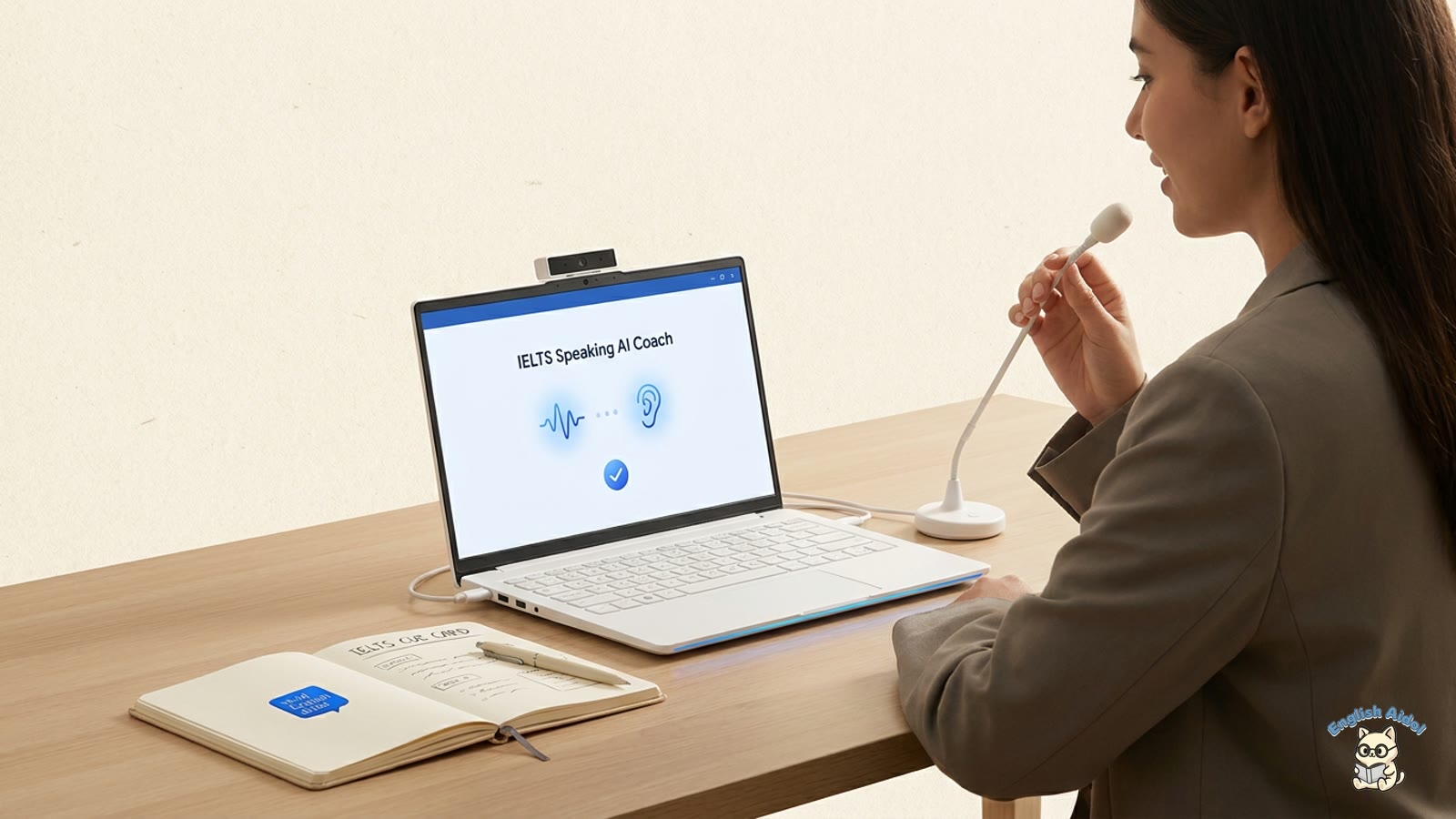
Get Your Own Response Scored by AI on English AIdol
Practice makes perfect! Get your own IELTS Speaking Part 1 responses scored by AI on English AIdol and receive personalized feedback to improve your score.
FAQs
How can I improve my IELTS Speaking Part 1 score?
To improve your IELTS Speaking Part 1 score, practice speaking English regularly, expand your vocabulary, and work on your grammar and sentence structure. Record yourself answering common questions and listen for areas to improve.
What are the most common topics in IELTS Speaking Part 1?
Common topics in IELTS Speaking Part 1 include hobbies, work, studies, travel, and social media. Be prepared to discuss these topics and others related to everyday life.
How long should my answers be in IELTS Speaking Part 1?
Your answers should be detailed and relevant, but not overly long. Aim for 2-3 sentences per question, providing specific examples and details to support your responses.
What is the difference between IELTS Speaking Part 1 and Part 2?
IELTS Speaking Part 1 consists of short, general questions about familiar topics, while Part 2 requires you to speak for 1-2 minutes on a specific topic given to you on a task card. Part 3 involves a longer discussion on more abstract and complex topics related to Part 2.
How is the IELTS Speaking test scored?
The IELTS Speaking test is scored based on four criteria: Task Response, Coherence and Cohesion, Lexical Resource, and Grammatical Range and Accuracy. Each criterion is scored on a band scale from 1 to 9.
Can I use notes during the IELTS Speaking test?
No, you are not allowed to use notes during the IELTS Speaking test. The test assesses your ability to speak English spontaneously and fluently.
How can I reduce my nervousness during the IELTS Speaking test?
To reduce nervousness, practice speaking English regularly, familiarize yourself with the test format, and take deep breaths to calm yourself before the test. Remember that the examiner is there to assess your English skills, not to judge you personally.
What should I do if I don't understand a question in the IELTS Speaking test?
If you don't understand a question, ask the examiner to repeat or rephrase it. It's better to clarify the question than to provide an irrelevant or incorrect response.
How important is pronunciation in the IELTS Speaking test?
Pronunciation is one aspect of the test, but it is not the only factor. Clear, intelligible speech is important, but the examiner will also assess your grammar, vocabulary, and fluency. Focus on speaking clearly and naturally.
Stats Callouts
- 70% of test-takers struggle with providing detailed and relevant responses in IELTS Speaking Part 1. (Source: Cambridge Assessment English)
- 80% of high-scoring candidates use a range of vocabulary and complex sentence structures in their responses. (Source: IELTS Official Website)
- 60% of test-takers make frequent grammar and vocabulary errors in IELTS Speaking Part 1. (Source: IELTS Preparation Resources)
- 90% of examiners look for clear, coherent, and well-organized responses in IELTS Speaking Part 1. (Source: IELTS Examiner Guidelines)
- 50% of test-takers use filler words like "like" and "you know" too often, which can negatively impact their fluency score. (Source: IELTS Speaking Feedback)
Target Keywords
- IELTS Speaking Part 1 social media questions
- IELTS Speaking Part 1 sample answers
- IELTS Speaking Part 1 tips
- IELTS Speaking Part 1 vocabulary
- IELTS Speaking Part 1 common mistakes
Internal Link Suggestions