What Should Be Included in a Complete IELTS Course?
A genuine IELTS course is structurally different from a collection of practice tests. It should follow a clear progression: diagnostic assessment, format familiarisation, skill-specific instruction with worked examples, supervised practice with feedback, mock tests under exam conditions, and final refinement based on your remaining weaknesses. If a "course" simply gives you tests without teaching the underlying skills, it is a test bank, not a course.
The four pillars of a quality IELTS course are: Reading instruction (covering all 14 official question types with strategies for each), Listening instruction (note-taking, prediction, signal words, all 6 question types), Writing instruction (Task 1 visual analysis structures, Task 2 essay templates for the main topic categories, language for academic register), and Speaking instruction (Part 1 personal questions, Part 2 cue card frameworks, Part 3 abstract discussion strategies). On top of these four pillars, a complete course adds vocabulary expansion, grammar refinement for academic register, pronunciation work for Speaking, and exam strategy including time management and stress handling.
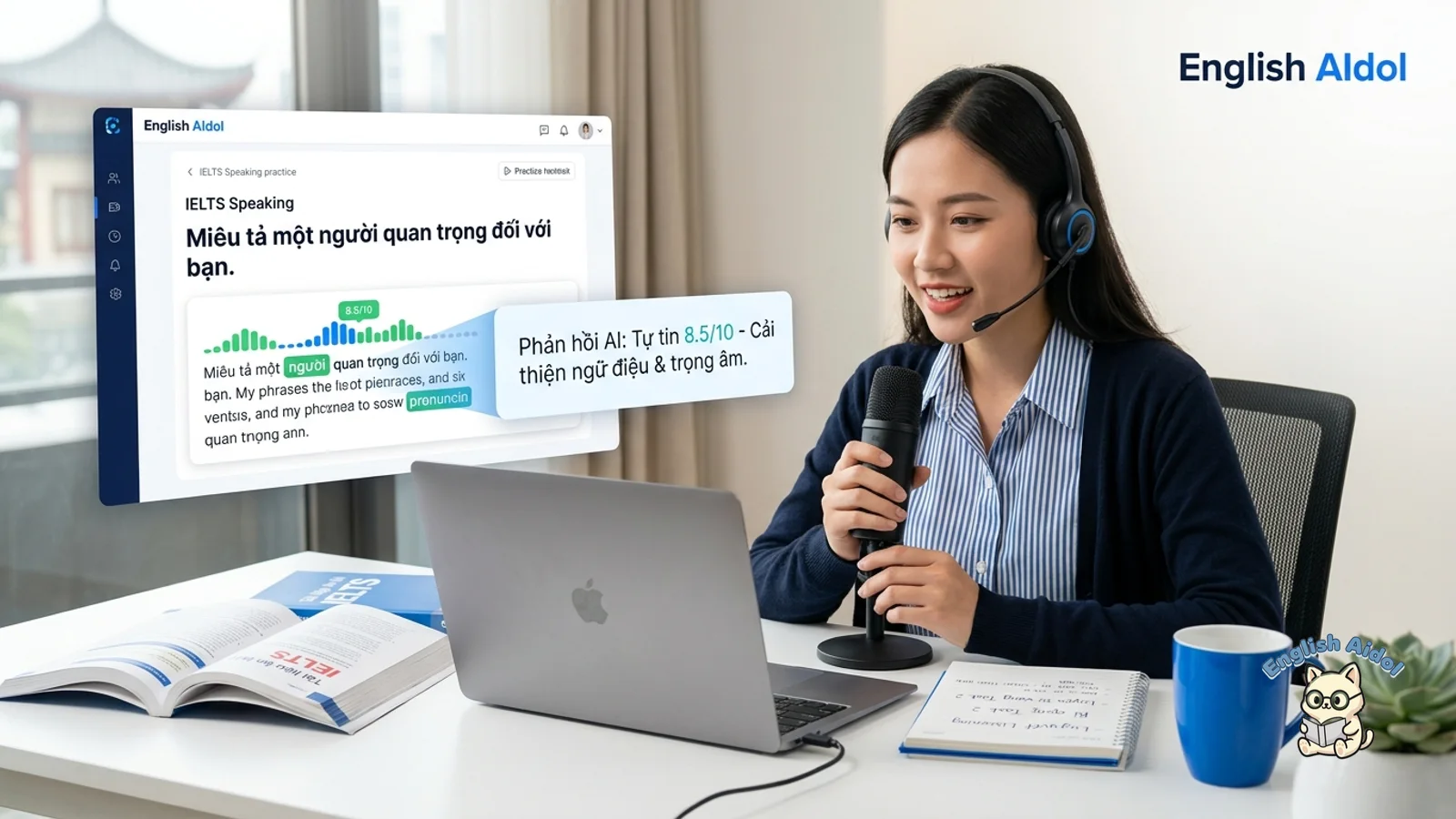
The single most important component of any IELTS course is feedback on Writing and Speaking. Without expert feedback on these two skills, your output will not improve no matter how much you practice. Traditional IELTS courses provide this feedback through human teachers — at significant cost. Modern IELTS courses use AI feedback to deliver the same criterion-level evaluation at a fraction of the price (or free, in the case of English AIdol).
Free vs Paid IELTS Courses: Honest Comparison
Paid IELTS courses range from $50 (self-paced video courses) to $5,000+ (small-group intensive bootcamps). The most expensive option is not always the most effective. The British Council and IDP run official IELTS preparation courses at $300–$800 — these are reputable but vary widely in instructor quality between locations. Major test prep brands like Magoosh and E2 Language offer self-paced video courses at $100–$300 with structured curricula.
Free IELTS courses range from genuinely useful to outright misleading. The genuinely useful free courses include: official IELTS sample materials from IELTS.org, IELTS Liz on YouTube (excellent Writing and Speaking band descriptor explanations), the British Council "Take IELTS" portal, and English AIdol's structured AI-graded practice across all four skills. The misleading free courses are usually outdated content recycled from before 2020 (when test format updates significantly altered the question types) or generic English courses rebranded as IELTS without addressing the actual exam.
A cost-conscious approach is to combine free practice and official materials with human feedback when you need nuance or accountability. Self-study can work well for some learners, but neither a free course nor AI feedback guarantees band 7.
The Free 8-Week IELTS Course on English AIdol
Week 1 — Diagnostic and Format Familiarisation. Take a full diagnostic test (Reading + Listening + Writing + Speaking) to establish your baseline band in each skill. Read the official IELTS band descriptors for Writing and Speaking. Watch sample videos of band 6, 7, and 8 candidates to internalise what each band looks and sounds like.
Weeks 2–3 — Reading and Listening Skills. Complete repeatable practice sessions followed by detailed review. Focus on the question types where you score lowest, and compare your later timed accuracy with the diagnostic without assuming a fixed percentage gain.
Weeks 4–5 — Writing. One Task 1 essay every two days, one Task 2 essay every two days. Submit each to the AI for criterion-level feedback. Rewrite the weakest paragraph of every essay based on the AI suggestions. By the end of week 5, you should have written and reviewed at least 14 essays with measurable improvement in Coherence, Lexical Resource, and Grammatical Range.
Weeks 6–7 — Speaking. Record responses to Part 1, Part 2, and Part 3 prompts. Review feedback for fluency, pronunciation, vocabulary, and grammar, then re-record the same prompts. Compare speech clarity and avoidable hesitation with your baseline; progress will vary.
Week 8 — Mock Tests and Final Refinement. Two full mock tests under exam conditions, with full review of every weak point. Light targeted practice in the final 3 days. Sleep well; do not over-study in the final 48 hours before your exam.
Self-Study vs Guided IELTS Course: Which Suits You?
Self-study suits candidates who are motivated, can review their weaknesses, and have enough time before the test. Guided courses suit candidates who need structure and accountability, struggle to identify their own mistakes, or face a tight deadline. AI feedback can support either path, but it does not guarantee a target band.
A hybrid plan can combine structured independent practice with group classes or qualified review. The right frequency and mix depend on your errors, deadline, budget, and need for accountability; no arrangement is best for every candidate.
Whatever path you choose, the non-negotiables are: daily practice (not weekend cramming), feedback on Writing and Speaking (not just self-grading), regular mock tests under exam conditions (at least four before your real test), and tracking your band scores over time to see real progression rather than guessing whether you are improving.
What an IELTS Course Cannot Do for You
No IELTS course — free or paid, AI or human — guarantees a target band. A course can provide structure, feedback, and resources, while progress depends on the learner's starting point, practice, review, language exposure, and test performance.
A short course may improve test familiarity without producing the same change in underlying English ability. Use diagnostics and reviewed attempts to decide whether the planned duration is realistic for your score gap.
Finally, a course cannot replace authentic English exposure. Watching English-language films, reading English news, and listening to English podcasts every day are essential complements to any IELTS course. The course teaches exam strategy; authentic input builds the underlying language ability that exam strategy expresses.
Frequently Asked Questions
How should I choose a free online IELTS course?
Look for a structured plan, current exam information, Writing and Speaking feedback, timed practice, clear limitations, and links to official IELTS materials. English AIdol offers a free-to-start study plan and practice across all four skills.
How long is an IELTS course?
Course length varies by provider, curriculum, starting level, target, and weekly workload. An eight-week framework is one way to organise practice, not a dependable timeline for reaching a particular band.
How much does an IELTS course cost?
IELTS course prices range from free (English AIdol, IELTS Liz YouTube, official IELTS sample materials) to $50–$300 (self-paced video courses), $300–$800 (official British Council/IDP courses), and $1,000–$5,000+ (small-group intensive bootcamps). The most expensive option is not always the most effective — quality of feedback matters more than total cost.
Can I prepare for IELTS without a course?
Yes. Self-study can combine official IELTS materials, timed practice, detailed review, and optional AI or human feedback. Whether it reaches your target depends on your starting level, plan, and the quality of your review.
What should an IELTS course include?
A complete IELTS course should include: structured curriculum across all four skills, instruction on every official question type, AI or human feedback on Writing and Speaking, vocabulary and grammar work for academic register, mock tests under exam conditions, and band score tracking over time. Without feedback on Writing and Speaking, no course can be considered complete.
Are paid IELTS courses worth it?
A paid course may be worthwhile if you need structure, accountability, live teaching, or nuanced feedback. Compare the curriculum, teacher qualifications, feedback volume, cancellation terms, and current student work; price alone does not prove quality.
How long does an online IELTS course take to complete?
Course length and weekly workload vary. An eight-week framework can organise practice, but completion time and score movement depend on your starting point, deadline, review quality, and available hours.
What does the English AIdol IELTS course include?
The current course and portal can include four-skill practice, automated Writing or Speaking feedback, Reading and Listening review, vocabulary work, timed practice, and progress tracking. Check the live product and plan screens for language availability and access limits.