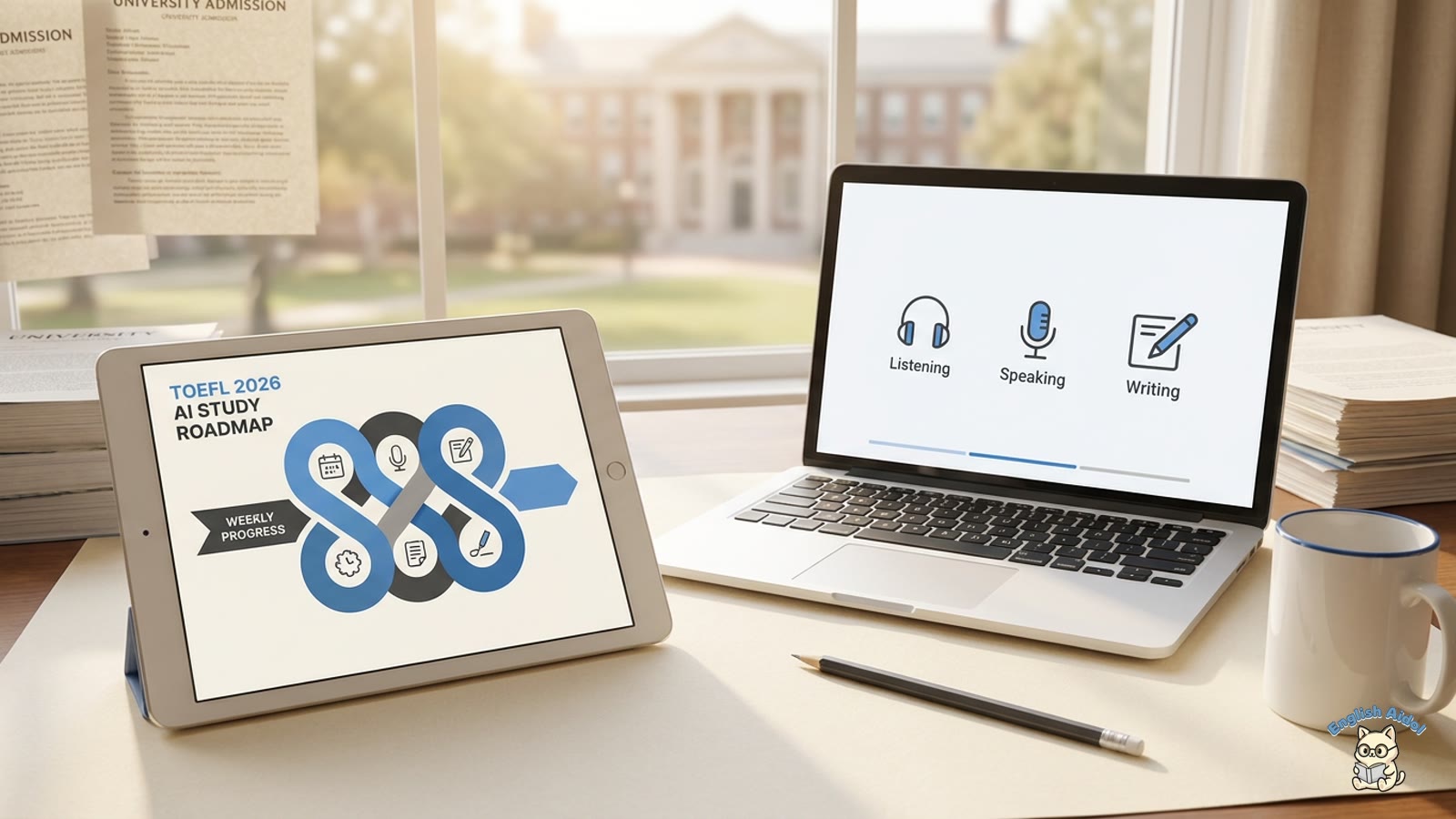
The Prompt (2026 Academic Discussion Format)
Professor: This semester, our university is evaluating whether to require more collaborative group projects or maintain a focus on independent assignments. Some students argue that teamwork builds essential communication and problem-solving skills for modern careers. Others believe that working alone allows deeper focus, individual accountability, and faster completion times. What is your opinion, and why? Please share your perspective in at least 100 words.
Related guides:
Note: The 2026 TOEFL Academic Discussion task runs for exactly 10 minutes. ETS expects 100-150 words. Responses under 100 words trigger automatic lexical penalty. Scores are reported on the 0-5 raw scale, dual-converted to the legacy 0-120 scale during the two-year transition period. Results arrive in 72 hours.
Model Responses by Score Band
Score 5.0 / CEFR C1 (Top Tier)
I strongly support shifting toward collaborative group projects because they mirror actual workplace dynamics and accelerate skill acquisition. In professional settings, employees rarely solve complex problems in isolation. For instance, during my internship at a renewable energy firm, our engineering team completed a solar efficiency simulation only by dividing tasks—data collection, coding, and peer review. This division of labor not only reduced our timeline by forty percent but also exposed each member to specialized techniques we would never encounter individually. Furthermore, group work forces students to negotiate conflicting perspectives, a competency consistently ranked among the top ten employability traits by the World Economic Forum. While independent study certainly builds concentration, it often lacks the iterative feedback loop that peer critique provides. When I draft research proposals alone, I routinely overlook methodological gaps that a single discussion partner immediately identifies. Universities that prioritize team-based assignments therefore produce graduates who are both technically proficient and socially adaptive. The academic environment should function as a training ground for collaborative industries, not an isolated testing laboratory.
Score 4.0 / CEFR B2+ (Strong but Flawed)
I believe group work is more beneficial than individual assignments for several reasons. First, working in a team helps students learn how to communicate effectively. When you have to explain your ideas to classmates, you clarify your own thinking and receive immediate feedback. For example, in my marketing class last year, our group had to design a campaign. At first we disagreed on the target audience, but after two meetings we combined our research and created a much stronger proposal than I could have made alone. Second, group projects prepare students for real jobs. Most companies expect employees to work together on deadlines and share responsibilities. If students only work individually, they miss out on developing teamwork skills that employers value highly. Some people argue that individual work is better because it allows you to focus without distractions. That might be true for simple tasks, but complex assignments require different viewpoints to succeed. Therefore, I think universities should require more group assignments to build essential professional competencies before graduation.
Score 3.0 / CEFR B1+ (Developing Control)
In my opinion, group work is better than individual work because students can help each other and learn faster. When I study alone, sometimes I get stuck on a hard question and waste time. But when I work with friends, we can share ideas and solve problems together. For example, in my biology class we had a big project about ecosystems. My partner was good at drawing diagrams and I was better at writing explanations. We divided the work and got a good grade. Also, group work is good for future jobs because many offices need teamwork. If you never practice working with others in college, it will be difficult when you start working. Some people say individual work is better because you can work fast and dont have to wait for others. I understand that point, but I think the benefits of collaboration are bigger. Teachers should assign more group projects so students can practice communication and cooperation.
Score 2.0 / CEFR A2-B1 (Limited Development)
Group work is very important. I like study with others. Individual work is boring and hard. When I do homework alone, I feel tired. But with classmates, we can talk about answers. For example, last week we had math group. We share calculator and help each other. The teacher give good grade. I think university should make more group project. It is good for future. Companies want team worker. If student only do alone work, they no know how to cooperate. Some people say alone work is faster. Maybe, but quality is low. Group work make better result. I strongly agree with professor that teamwork is better for learning.
Scoring Breakdown (2026 TOEFL Academic Discussion Rubric)
| Score | Task Achievement & Development | Lexical Resource | Grammatical Range & Accuracy | Cohesion & Organization | |-------|-------------------------------|------------------|------------------------------|------------------------| | 5.0 | Directly answers prompt, develops position with two specific, well-explained reasons, integrates concrete real-world examples. Fully addresses the 10-minute constraint with 138 highly relevant words. | Precise academic vocabulary (`iterative feedback loop`, `methodological gaps`, `socially adaptive`). Zero repetition. | Complex structures used accurately (participial phrases, conditional logic, relative clauses). Punctuation flawless. | Seamless progression using discourse markers (`Furthermore`, `While`, `When`, `Therefore`). Logical paragraph unity. | | 4.0 | Clear stance, two relevant points with one extended example. Minor gaps in depth. Meets length requirement. | Solid range (`clarify your own thinking`, `conflicting perspectives`, `competencies`). Occasional repetition of `group work`. | Mostly error-free complex sentences. One minor article/preposition issue. | Clear progression with standard linkers (`First`, `Second`, `Therefore`). Slightly formulaic transitions. | | 3.0 | Answers prompt but development remains surface-level. Example is relevant but lacks analytical depth. Meets minimum length. | Adequate but basic (`help each other`, `good grade`, `hard question`). Limited academic register. | Frequent simple structures. Several minor errors (`teachers should assign`, missing articles). | Basic connectors (`Also`, `Some people say`, `I think`). Paragraphing present but ideas overlap. | | 2.0 | Position stated but underdeveloped. Examples are vague or anecdotal. Fails to engage with counterargument. Under 100 words triggers scale penalty. | Highly repetitive, basic lexical set (`good`, `bad`, `tired`, `important`). | Frequent errors in agreement, tense, and sentence boundaries (`teacher give`, `they no know`). | Choppy sequencing, minimal cohesion. Reads as isolated statements. |
15+ Essential Vocabulary Highlights
- collaborative dynamics (n.) — The interactive patterns that emerge when people work together. Collocation: `foster collaborative dynamics`
- skill acquisition (n.) — The process of learning a new ability through practice. Collocation: `accelerate skill acquisition`
- division of labor (n.) — Allocating specific tasks to different members. Collocation: `strategic division of labor`
- iterative feedback loop (n.) — A cycle where output is repeatedly reviewed and improved. Collocation: `establish an iterative feedback loop`
- methodological gaps (n.) — Flaws in research design or process. Collocation: `identify methodological gaps`
- socially adaptive (adj.) — Capable of adjusting to interpersonal environments. Collocation: `produce socially adaptive graduates`
- employability traits (n.) — Qualities that make a candidate hireable. Collocation: `highly sought employability traits`
- conflicting perspectives (n.) — Differing viewpoints that require resolution. Collocation: `navigate conflicting perspectives`
- competencies (n.) — Demonstrated abilities or skills. Collocation: `develop core professional competencies`
- iterative critique (n.) — Repeated evaluation for improvement. Collocation: `benefit from peer iterative critique`
- accountability (n.) — Responsibility for outcomes. Collocation: `ensure individual accountability`
- synergy (n.) — Combined effect greater than individual efforts. Collocation: `achieve academic synergy`
- delineate (v.) — To describe boundaries or distinctions clearly. Collocation: `delineate task responsibilities`
- consolidate (v.) — To combine separate elements into a unified whole. Collocation: `consolidate research findings`
- autonomous (adj.) — Independent, self-directed. Collocation: `foster autonomous learning habits`
5 Common Mistakes on Group vs. Individual Work Prompts
- Fencing-Sitting (No Clear Position): The 2026 ETS rubric explicitly penalizes responses that say "both have pros and cons" without stating a definitive stance. Pick a side in your first sentence.
- Generic Examples: Phrases like "group work is good because you can talk" score 2.0-3.0. Use specific, real-world scenarios (e.g., `engineering simulation`, `marketing campaign design`, `clinical trial data analysis`).
- Ignoring the 10-Minute/100-Word Constraint: Responses under 100 words automatically cap at 3.0. Over 170 words risk incomplete editing and grammatical collapse. Target 120-145 words.
- Repetitive Lexis: Recycling `teamwork`, `helpful`, `good grade` across sentences triggers low Lexical Resource scores. Swap with `collaborative dynamics`, `peer critique`, `competency acquisition`.
- Ignoring the Counter-Argument: Top scores require acknowledging the opposing view and refuting it (`While independent study builds concentration, it lacks the iterative feedback loop...`). Skipping this limits your score to 4.0 maximum.
6-Step Execution Strategy (10-Minute Timer)
- 0:00-0:30 → Read prompt, underline key terms, choose side immediately.
- 0:30-1:00 → Draft opening sentence stating position + reason 1.
- 1:00-3:30 → Develop reason 1 with a concrete, specific example.
- 3:30-6:00 → Introduce reason 2 OR refute counterargument with evidence.
- 6:00-8:30 → Write concise closing sentence reinforcing position. Do NOT use "In conclusion."
- 8:30-10:00 → Proofread for subject-verb agreement, article usage, and punctuation. Delete filler words.
Final Word
The January 21, 2026 TOEFL redesign demands precision, not length. Your response must function as a mini-argument: claim, evidence, implication. Practice under strict 10-minute conditions. Get your own response scored by AI on English AIdol.