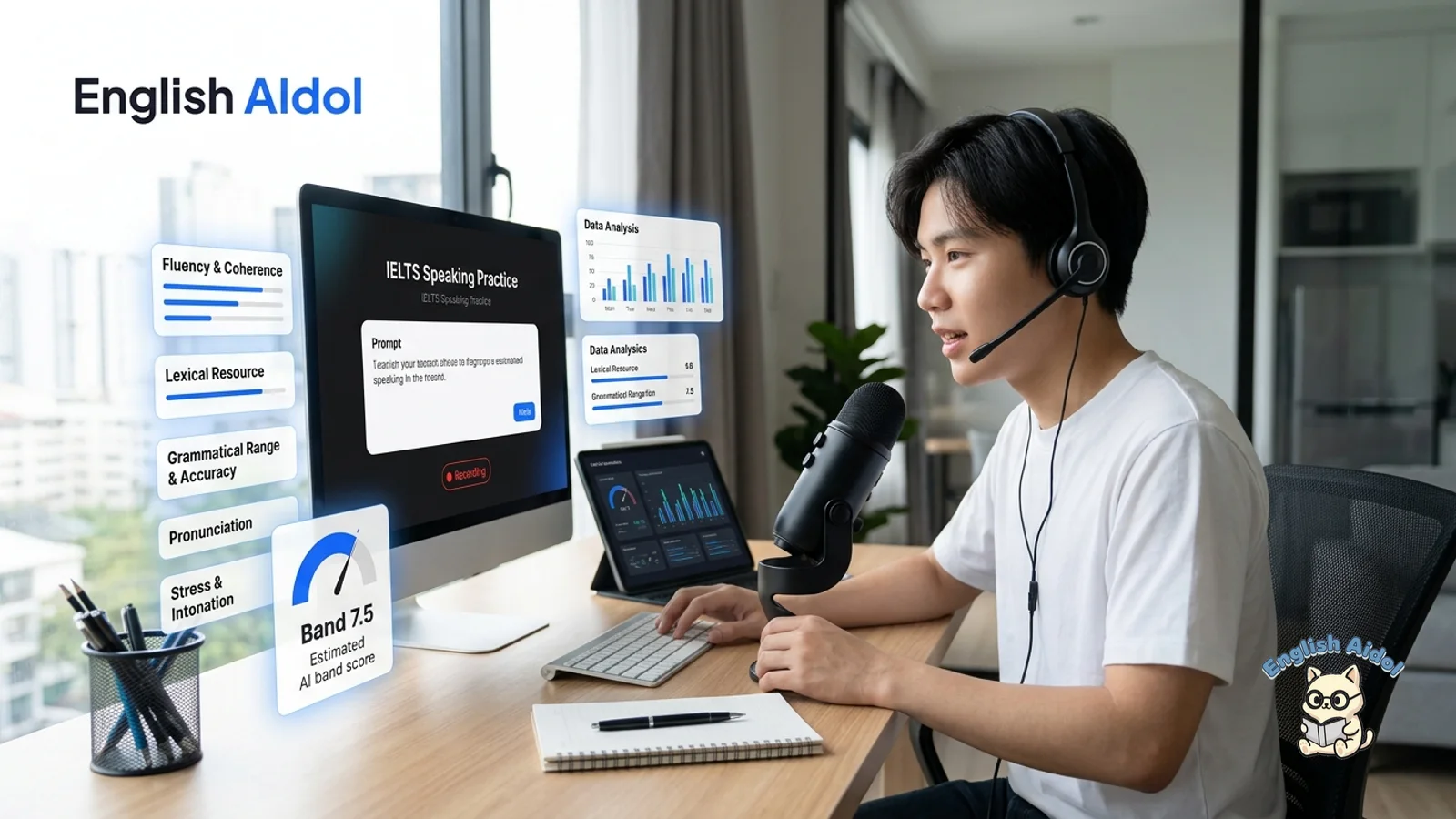
What Is IELTS AI and How Does It Work?
IELTS AI refers to automated practice tools that review responses and may organise feedback around the published IELTS criteria. A provider should not claim examiner equivalence, special training data, or a dependable score margin without relevant published evidence.
For Reading and Listening, AI scoring is straightforward because answers are objective — the AI checks correctness against the answer key and converts your raw score to the IELTS 9-band scale. The hard part is Speaking and Writing, which require qualitative judgement. Modern IELTS AI systems use large language models to analyse essay structure, vocabulary range, grammatical variety, and argumentation depth. For Speaking, the AI transcribes your audio, measures speech rate and pause patterns to estimate fluency, evaluates pronunciation clarity using phoneme-level analysis, and scores grammar and vocabulary against band descriptors.
A useful IELTS AI system should explain its estimate. Look for feedback tied to specific sentences or moments in a recording, then test the advice in a rewrite or re-recording. Saved history can reveal recurring issues, but an upward AI trend is not a guarantee of an official score.
Is AI IELTS Scoring Accurate? How It Compares to Human Examiners
AI band estimates can be useful for repeated practice, but their error rate varies by tool, response, accent, task, and scoring design. Without a published validation study for a specific system, do not assume a fixed margin from a human examiner. Use the criterion feedback and confirm high-stakes readiness with official practice and qualified review.
Automated systems may handle unusual structures, topic relevance, accents, audio quality, and pragmatic context differently. Inspect feedback tied to the actual response and do not infer an official band from one estimate.
Speaking tools may surface pace, pauses, transcription, pronunciation, grammar, or vocabulary signals, but their coverage and error rate vary. Qualified human review remains useful when context, nuance, or a high-stakes deadline matters.
Check Access Before Starting
English AIdol offers practice across the four skills, while access limits and included feedback depend on the current feature and plan. Check the relevant practice or pricing screen rather than relying on a permanent "free" or "unlimited" claim.
When comparing tools, look for transparent submission limits, criterion-level comments tied to your response, privacy information, and clear disclaimers that an automated band is unofficial.
A practical routine might combine regular Speaking recordings, Writing revisions, and timed Reading or Listening review. Choose a workload you can sustain, measure recurring errors, and adjust the plan rather than assuming a fixed practice volume will produce a specific band gain.
How to Compare IELTS AI Tools in 2026
Compare tools by criterion-level feedback, evidence from your own response, free access, language support, privacy, and clear limitations. English AIdol provides practice across all four skills and supports several learner interfaces, including Korean, Japanese, Vietnamese, Indonesian, Arabic, and Chinese. Test more than one response before deciding whether any tool's feedback is useful for you.
Other AI IELTS platforms tend to specialise — some focus on Writing-only AI feedback, others on Speaking simulation, and a few on full-test mock exams. The right choice depends on which skill you most need to improve. If your weakness is Writing, choose a platform with detailed criterion-level essay feedback (not just a generic grammar checker). If your weakness is Speaking, choose a platform that records your audio and gives pronunciation-level feedback (not just transcription with grammar correction). If you need full exam simulation, look for platforms that offer timed full-length tests across all four skills with AI-graded results.
Avoid: AI tools that promise unrealistic score guarantees ("Band 8 in 2 weeks!"), platforms that do not show their feedback methodology, and tools that score your essay without explaining how. Reliable IELTS AI is transparent — you should always be able to see why you received a particular band estimate and what specific changes would move you up or down.
How to Use IELTS AI Most Effectively
Set a baseline. Before optimising your study, complete one full AI-graded mock test in each of the four skills. Note your starting band in each. This baseline lets you measure real progress rather than guessing.
Focus from evidence. Compare each section with your exact requirement and give extra attention to the section below it. Maintain the other skills and avoid assuming a typical gap or guaranteed fastest route.
Use AI feedback actively, not passively. Reading the feedback is not enough. After every AI-graded essay, rewrite the worst paragraph based on the AI suggestions. After every AI-graded speaking response, re-record the same answer applying the feedback. This rewrite step is what turns AI feedback into actual skill improvement.
Combine practice with authentic input. Read and listen to material suitable for your level, then apply useful language in Writing or Speaking. Choose a sustainable workload; no fixed daily duration guarantees a band gain.
Inspect trends carefully. Compare several similar attempts, but remember that a rising AI average may reflect task mix or model variance as well as skill. Confirm readiness with current official materials.
IELTS AI and Human Tutoring Serve Different Roles
Automated feedback can support repeated independent practice, while a qualified teacher can add context, accountability, and nuanced judgement. Availability, pricing, consistency, and teacher quality vary, so neither option is universally better.
A hybrid approach may work for some learners, but the right practice and review frequency depends on the learner, deadline, budget, and quality of the available feedback.
For candidates with a limited budget, AI can add practice volume between official materials and occasional human review. It cannot guarantee band 7 or replicate every judgement a qualified examiner or teacher makes.
Frequently Asked Questions
What is IELTS AI?
IELTS AI refers to automated practice tools that provide answer review or organise feedback around published IELTS criteria. Their scores are unofficial estimates and should not be presented as examiner-equivalent.
Is AI IELTS scoring accurate?
AI scoring is an unofficial practice estimate whose accuracy varies by tool and response. Use criterion-level feedback and trends across several attempts, and confirm high-stakes readiness with official materials or qualified human review.
Is there free AI IELTS practice?
Some practice may be available without payment, while submission limits and feedback depth depend on the current feature and plan. Check the app or pricing page for live details.
Can AI replace a human IELTS tutor?
AI can support frequent independent practice, but it cannot replace every kind of human feedback, motivation, or pragmatic judgement. Combine it with official materials and qualified review when your target or deadline makes accuracy important.
How does IELTS AI Speaking practice work?
You record your spoken response into your microphone. The AI transcribes your audio, measures fluency (speech rate, filler words, pause patterns), evaluates pronunciation clarity, scores grammar and vocabulary against the IELTS Speaking band descriptors, and gives a predicted band score with specific feedback on what to improve.
How does IELTS AI Writing feedback work?
You submit your essay. The AI evaluates it against the four official Writing criteria (Task Achievement, Coherence & Cohesion, Lexical Resource, Grammatical Range & Accuracy), highlights specific sentences with errors, suggests stronger vocabulary and grammar alternatives, and gives a predicted band score for each criterion plus an overall estimate.
Which AI IELTS tool should I choose in 2026?
Choose based on your weakest skill, feedback depth, evidence tied to your response, privacy, practice limits, and language support. English AIdol offers all-skills practice in several interface languages; compare the usefulness of feedback on your own work before relying on any estimate.
Can I use AI to prepare for IELTS without paying?
Some tools offer no-cost practice with limits that can change. Check the current plan, combine independent tools with official samples, and do not treat free or paid access as a score guarantee.