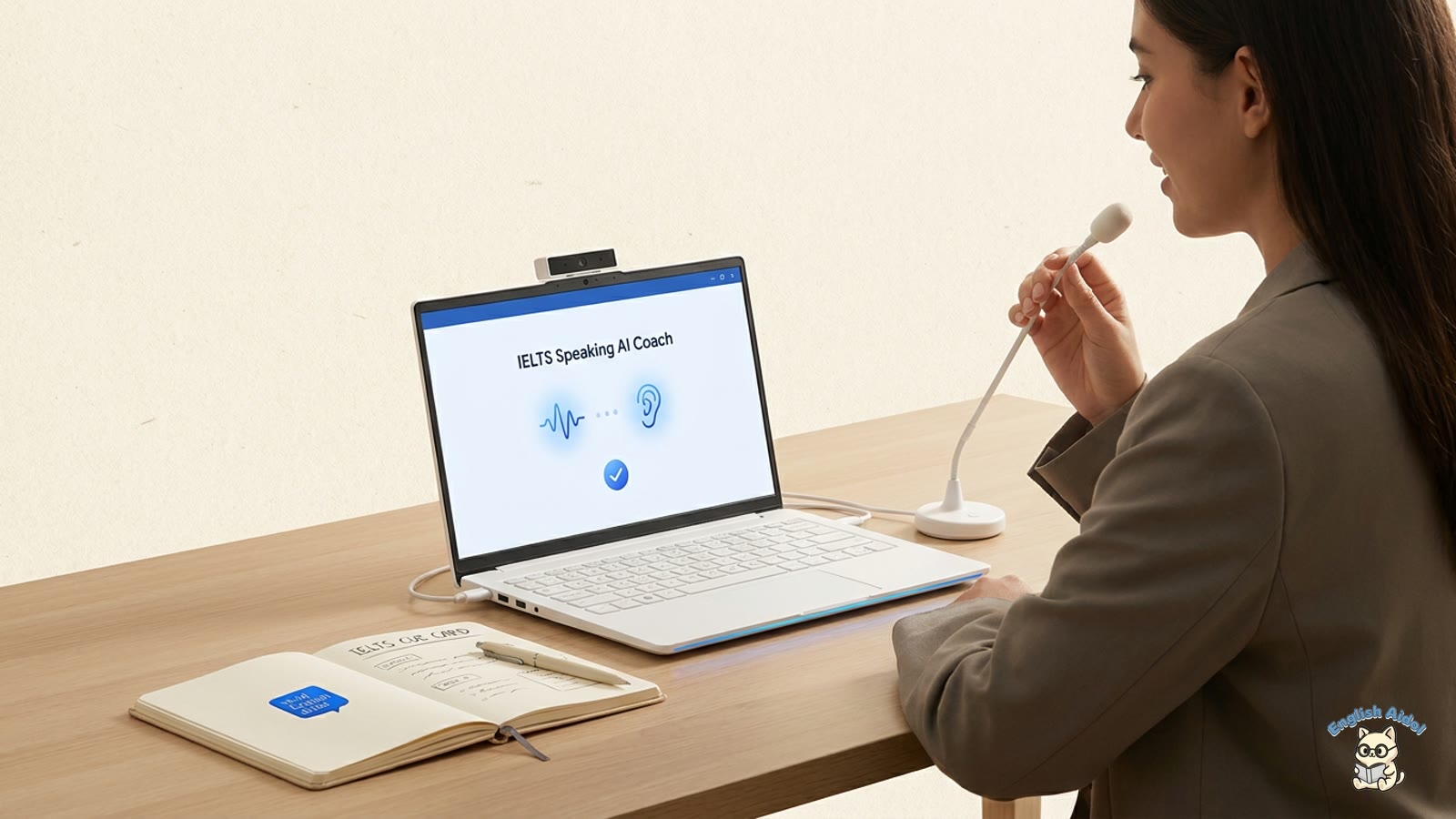
To achieve an IELTS Band 7 in Speaking, you must demonstrate a good command of English with occasional inaccuracies, speak at length without noticeable effort, use a range of complex structures and vocabulary, and maintain fluency with only occasional repetition or self-correction. It's the bridge between competence and true operational command of the language.
**Related guides:**
- [Why I Built an AI IELTS Grader That Replaces the…](/en/blog/why-i-built-english-aidol-founder-story)
- [How to Answer NCLEX Questions About Pain Management Like a…](/en/blog/how-to-answer-nclex-questions-about-pain-management-like-a-pro)
- [Free IELTS Practice Tests Online: The Best Resources in 2026](/en/blog/free-ielts-practice-tests-online-2026)
- [How Many Hours a Day Should I Study for IELTS? Expert Advice](/en/blog/how-many-hours-a-day-should-i-study-for-ielts-expert-advice)
- [The 5 IELTS Writing Mistakes That Cap You at Band 6 (And…](/en/blog/ielts-writing-mistakes-band-6-ceiling)
## What Does an IELTS Band 7 in Speaking Mean?
According to the official IELTS band descriptors, a Band 7 speaker is classified as a "Good User." The examiner will be looking for specific evidence of your skills. Crucially, you need to show you can handle the unexpected. While a Band 6 speaker can talk on familiar topics, a Band 7 candidate can effectively discuss more abstract and unfamiliar subjects in Part 3. You are expected to use some idiomatic language, paraphrase successfully when you can't find a precise word, and show flexibility in your grammatical structures.
## 5 Actionable Tips for IELTS Speaking Band 7
Moving from a Band 6 to a Band 7 requires a strategic shift in focus. These five tips target the specific criteria examiners use to award higher marks.
### 1. Extend Your Answers with the "What, Why, How" Method
Short, direct answers are the enemy of a high score. For every question, especially in Parts 1 and 3, train yourself to develop your response immediately. Use a simple mental framework: State your answer (What), give a reason (Why), and provide an example, consequence, or contrast (How/What else).
Example: Question: "Do you enjoy reading?"
Basic Answer: "Yes, I do." (Insufficient)
Band 7 Answer: "Yes, I'm quite an avid reader, particularly of science fiction. I find it helps me escape from daily stress and stimulates my imagination. For instance, recently I've been immersed in the works of Andy Weir, which make complex scientific concepts incredibly accessible."
### 2. Master the Art of Paraphrasing
At Band 7, you won't always know the exact word. Instead of hesitating or using the wrong word, demonstrate your vocabulary resource by paraphrasing. This directly impacts your Lexical Resource score.
- Instead of "a very old building," say "a historical landmark" or "an ancient piece of architecture."
- Instead of "a happy memory," try "a nostalgic moment" or "a cherished recollection."
- If you forget the word "greenhouse," you could say "a glass structure for growing plants in a controlled climate."
Platforms like English AIdol are excellent for practicing this skill, as they can provide instant feedback on your alternative phrasing.
### 3. Use a Mix of Complex Sentence Structures
Grammar (Grammatical Range and Accuracy) is heavily weighted. You must move beyond simple sentences. Aim to naturally use a combination of:
- Compound Sentences: "I enjoy hiking, and I try to go every weekend."
- Complex Sentences: "Although I enjoy hiking, I don't like going in the rain."
- Conditionals: "If I had more free time, I would probably take up photography."
- Relative Clauses: "The book, which was a gift from my father, changed my perspective."
Aim for 1-2 error-free complex structures per minute of speech. Occasional minor errors are acceptable at Band 7, but the range must be evident.
### 4. Incorporate "Band 7 Vocabulary" Naturally
This doesn't mean using obscure words incorrectly. It means using topic-specific vocabulary accurately. Before the test, brainstorm vocabulary for common topics (education, environment, technology, family, hobbies). Learn collocations (e.g., "make a mistake," not "do a mistake"; "heavy traffic," not "strong traffic") and a handful of well-understood idioms (e.g., "once in a blue moon," "a drop in the ocean").
### 5. Focus on Fluency First, Accuracy Second
Many candidates sacrifice fluency by self-correcting every tiny mistake. At Band 7, fluency and coherence contribute 25% of your score. Speak at a natural pace. If you make a small grammatical error (e.g., "he go" instead of "he goes"), keep going. Only correct yourself if the mistake significantly obscures your meaning. The examiner wants to hear a steady, confident flow of ideas.
## Your 4-Week Preparation Plan for Band 7
Consistent, focused practice is key. Here’s a simple weekly plan:
- Weeks 1-2: Daily 15-minute practice on common Part 1 & 2 topics. Record yourself and analyze for fluency and answer length.
- Week 3: Focus on developing Part 3 answers. Practice the "What, Why, How" method on abstract questions about society, technology, and education.
- Week 4: Conduct 2-3 full mock speaking tests under timed conditions. Use an AI tutor like English AIdol for simulated practice or find a study partner to mimic the exam pressure.
## Common Pitfalls to Avoid for Band 7
Be aware of these frequent mistakes that hold candidates at Band 6:
- Memorizing Answers: Examiners can spot this instantly and will change the topic.
- Overusing Transition Words: Using "moreover" or "furthermore" in every sentence sounds unnatural.
- Asking the Examiner Questions: (e.g., "What do you think?") This is not a conversation.
- Stopping Completely: It's better to say something like, "That's an interesting question; let me think for a second," than to fall into silent panic.
Achieving an IELTS Speaking Band 7 is a realistic goal with targeted practice. By focusing on extending your answers, showcasing your vocabulary through paraphrase, using a mix of grammatical structures, and prioritizing fluent delivery, you will provide the clear evidence the examiner needs to award you that "Good User" band score.
Frequently Asked Questions (FAQ)
Is 7.0 a good score in IELTS Speaking?
Yes, a Band 7 in IELTS Speaking is considered a very strong score. It demonstrates a good operational command of spoken English and is accepted by most universities for undergraduate and postgraduate courses, as well as by many professional bodies for registration purposes.
Can I use idioms to get Band 7 in IELTS Speaking?
Used sparingly and correctly, idioms can enhance your Lexical Resource score. However, forcing them in unnaturally or using them incorrectly will harm your score. Aim to use 1-2 well-chosen, context-appropriate idioms in your test, particularly in Part 2.
How can I improve my fluency for IELTS Speaking?
Fluency improves with volume of practice. Speak English aloud daily, even if to yourself. Record your answers to common questions and listen back for frequent pauses or fillers ("um," "ah"). Practice thinking in English to reduce translation time. Tools like English AIdol that provide real-time conversation practice are highly effective for building this skill under pressure.