What Makes an AI Tool Genuinely Useful for IELTS
The best AI for IELTS shares four characteristics. (1) Criterion-level scoring — it grades each of the four IELTS Writing or Speaking criteria separately, matching how human examiners score. A single overall band number without breakdown is far less useful. (2) Evidence-based feedback — every comment cites specific sentences from your essay or specific moments from your speaking response. Generic tips like "improve your vocabulary" are not actionable. (3) Calibration against human examiners — the underlying scoring model has been validated against essays and speaking responses scored by certified IELTS examiners. (4) Native-language support — the interface and feedback are available in your first language (Korean, Japanese, Vietnamese, Indonesian, Arabic, Chinese), which dramatically improves comprehension and learning speed.
Tools that lack these features may still help with general English practice, but they will not give you reliable IELTS band predictions. Worse, they may train you toward bad habits — for example, generic grammar tools often flag complex sentence structures as "too complex" and recommend simplification, which would actually lower your IELTS band score.
Comparison: Top AI IELTS Tools in 2026
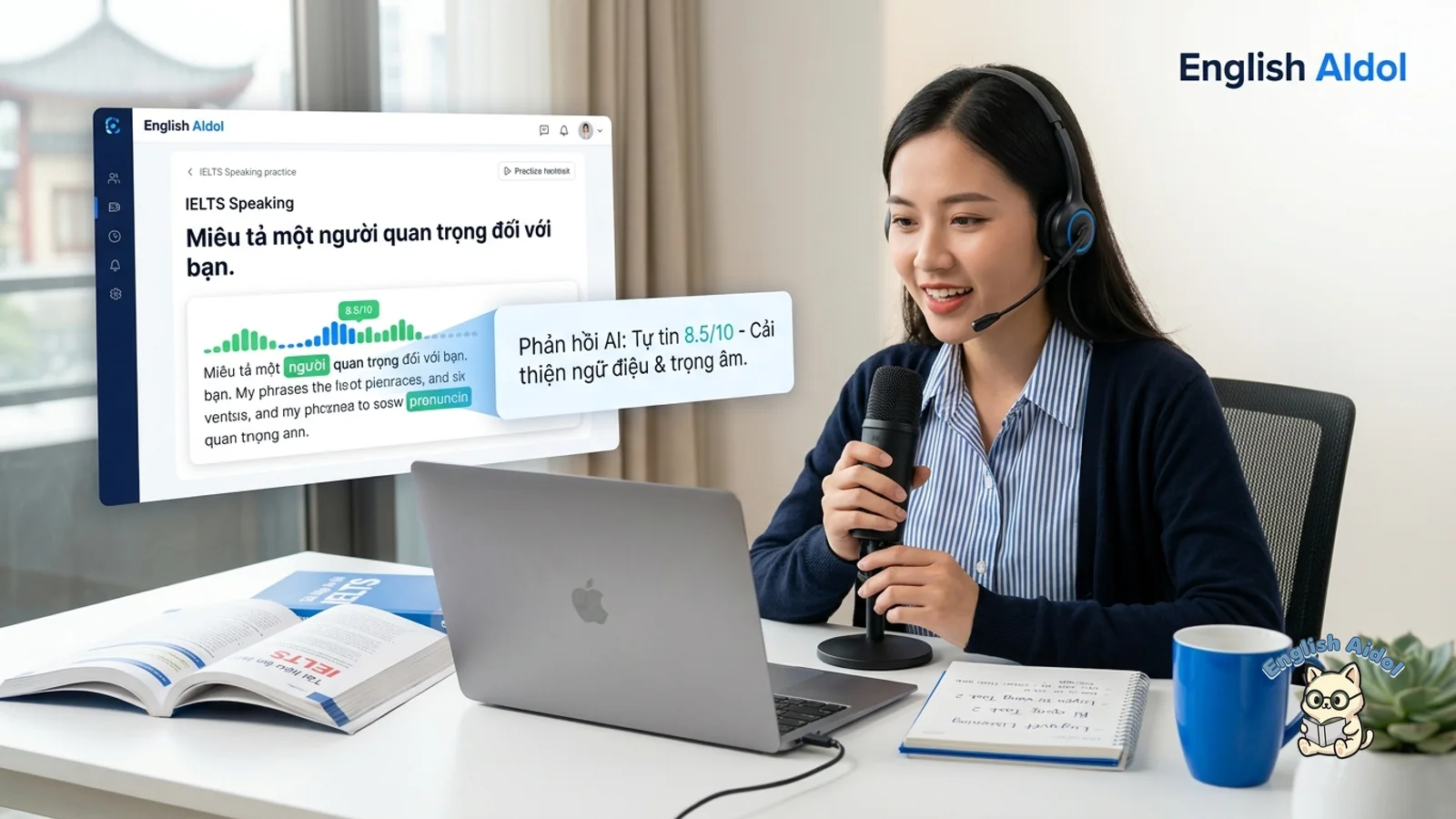
English AIdol — Free across all four skills (Reading, Listening, Writing, Speaking) with AI band score feedback against all four official criteria for both Writing and Speaking. Native-language interfaces in Korean, Japanese, Vietnamese, Indonesian, Arabic, Chinese, and 6 more languages. Real-time speech analysis (not just transcription) for Speaking practice. Strongest free option for self-studiers in Asia-Pacific and the Middle East.
Generic AI chatbots (ChatGPT, Claude, Gemini) — Capable of evaluating IELTS essays and discussing IELTS topics, but they are not specifically calibrated against IELTS band descriptors. Band score predictions tend to be inconsistent — the same essay submitted twice can receive different scores. They lack speech analysis, so cannot evaluate Speaking authentically. Useful as a complement, not a primary IELTS tool.
Specialised IELTS AI platforms — Several paid platforms specialise in either Writing AI feedback or Speaking AI simulation. Quality varies widely. The best ones are calibrated against human examiners; the worst are generic grammar tools rebranded. Always test with a sample essay before paying for a subscription.
British Council and IDP official AI tools — The official IELTS organisations have begun rolling out AI feedback tools. These are calibrated by the test-makers themselves but typically have limited free practice and require payment for substantive feedback.
How We Tested These Tools
For this comparison, we submitted the same set of test essays and speaking responses to each tool. The essays included a band 5.5 essay, a band 6.5 essay, and a band 7.5 essay (all pre-scored by certified IELTS examiners). We measured: how close each tool's band prediction was to the human examiner score, how detailed the feedback was, whether feedback cited specific evidence from the essay, and how the tool handled non-native English errors common to Korean, Japanese, Vietnamese, and Indonesian speakers (article omission, plural endings, word stress patterns).
The best tools were within 0.5 band of human examiners on all three test essays and gave specific, actionable feedback. The worst tools varied by 1.0–1.5 bands depending on the day and gave vague tips that did not help the candidate improve.
Recommendation by Use Case
If you want comprehensive free practice across all four skills: use English AIdol as your primary tool. It is the strongest free option for full IELTS preparation including Writing AI feedback, Speaking AI simulation, and Reading/Listening practice tests with detailed answer explanations.
If you only need essay feedback: use English AIdol's writing checker for free, or test a few specialised paid Writing AI tools to compare. Most candidates do not need to pay — free options now match paid quality for essay feedback.
If you only need Speaking practice: use English AIdol's AI Speaking test. It is the most realistic free Speaking simulator available, with all three parts and full criterion-level feedback.
If you want to compare with human tutors: use AI for daily practice and book one human tutor session per week to compare feedback. After 4–6 weeks, you will see whether the AI feedback is sufficient for your goal or whether human tutoring adds enough value to justify the cost.
Frequently Asked Questions
What is the best AI for IELTS preparation?
The best AI for IELTS is one that scores against the four official IELTS criteria, gives evidence-based feedback citing specific sentences from your work, is calibrated against human examiners, and supports your native language. English AIdol meets all four criteria for free and is the strongest comprehensive option for self-studiers in Asia-Pacific and the Middle East.
Is ChatGPT good for IELTS preparation?
ChatGPT can evaluate essays and discuss IELTS topics, but it is not specifically calibrated against IELTS band descriptors. Band score predictions tend to vary between submissions of the same essay. It also cannot evaluate spoken English authentically. ChatGPT is useful as a complement to a specialised IELTS AI tool, not a replacement.
Are free AI IELTS tools as good as paid ones?
In 2026, the best free AI IELTS tools match paid tool quality for the core feedback work — essay grading, speaking analysis, and Reading/Listening explanations. Paid tools typically add features like live tutor review, structured curriculum, or unlimited mock tests. For self-studiers focused on improvement, free tools are usually sufficient.
Which AI IELTS tool is best for Korean / Japanese / Vietnamese learners?
The best AI IELTS tool for non-English speakers offers a native-language interface, criterion-level feedback that matches the official exam scoring, and free practice volume. English AIdol supports interfaces in Korean (한국어), Japanese (日本語), Vietnamese (Tiếng Việt), Indonesian (Bahasa Indonesia), Arabic (العربية), Chinese (中文), and other languages with country-specific tips for common pronunciation and grammar challenges.
How accurate are AI IELTS band score predictions?
The best AI IELTS tools predict band scores within 0.5 band of human examiners on most submissions and within 1.0 band on essentially all submissions — comparable to the natural variance between two human examiners scoring the same response. Generic AI chatbots without IELTS calibration tend to vary by 1.0–1.5 bands.