How Long Does IELTS Preparation Actually Take?
The single most common question from new IELTS candidates is: "How long do I need to prepare?" The honest answer depends entirely on three factors: your current English level, your target band score, and how many hours per week you can realistically commit. With consistent study of 10–15 hours per week, moving from band 4 to band 5 typically takes 3–6 months. Going from band 5 to band 6 takes 2–4 months. Climbing from band 6 to band 7 requires 1–3 months of focused work, and progressing from band 7 to band 8 can take 3–6 months because the gap between bands grows wider at higher levels.
If you do not know your current level, the first step in any IELTS preparation plan is taking a diagnostic test. English AIdol provides free full-length IELTS practice tests that estimate your band in all four skills within an hour. This baseline prevents two common mistakes: overestimating your current level and being shocked on test day, or underestimating it and over-preparing for an exam you could already pass. Most candidates discover that their four skills are not balanced — for example, a Korean candidate may score band 7 in Reading but band 5.5 in Speaking, and a Vietnamese candidate may have strong Listening but weak Writing. Your study plan should not be one-size-fits-all; it should target your weakest skill first.
A realistic IELTS preparation timeline assumes you are studying actively, not passively. Watching English movies counts for very little compared to one hour of timed reading practice with detailed review of every wrong answer. The students who progress fastest are those who treat preparation like training for a competition: short, intensive sessions focused on one specific skill or question type, followed by careful review of mistakes. Two hours per day of focused study beats five hours of unfocused exposure every time.
The 8-Week IELTS Study Plan (Band 6 → Band 7)
Weeks 1–2: Diagnosis and Foundation. Take a full diagnostic test in week 1 — all four skills, timed, no breaks. Identify your weakest skill and the specific question types within each skill where you lose the most marks. Spend the rest of these two weeks understanding the test format thoroughly. Read the official IELTS band descriptors for Writing and Speaking so you know exactly what examiners look for. Watch a few official IELTS Speaking sample videos to internalise the pacing of band 7+ candidates.
Weeks 3–4: Reading and Listening. These two skills improve fastest because they have objective answers. Practice one full Reading test and one Listening section every other day. After each session, spend an equal amount of time reviewing — not just checking answers, but understanding why each correct answer is correct and where the evidence appears in the passage or audio. For Reading, focus on the question types that drop your score: True/False/Not Given, matching headings, and matching information are the most common weak points. For Listening, work on note completion and multiple choice, which require precise spelling and grammar.
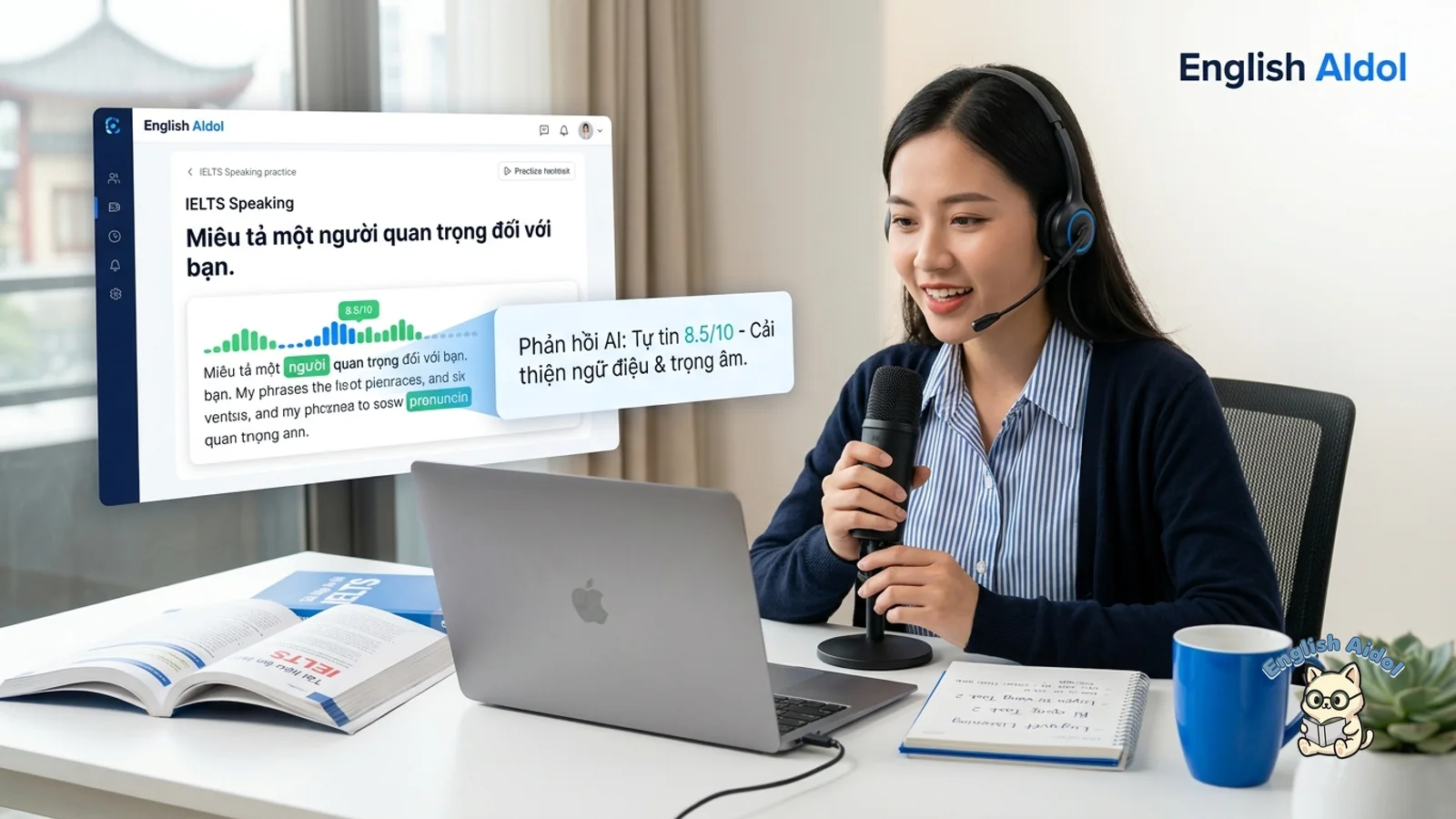
Weeks 5–6: Writing and Speaking. These productive skills require feedback to improve, which is why many self-studiers plateau here. Write at least one Task 1 and one Task 2 essay every two days. Submit each essay to English AIdol's AI for instant band-level feedback on Task Achievement, Coherence, Lexical Resource, and Grammatical Range — the same four criteria human examiners use. For Speaking, record yourself answering Part 1, Part 2, and Part 3 questions every day. Listen back. The AI feedback identifies pronunciation issues, filler words ("um," "uh," "like"), and grammar errors you would never catch alone.
Weeks 7–8: Mock Tests and Refinement. Complete two full mock tests under exam conditions — same start time as your actual test, no phone, no music, strict timing. Analyse your weaknesses one final time. In the last week, do light targeted practice only, sleep well, and avoid burning out. Many candidates over-study in the final days and underperform on test day from mental fatigue.
IELTS Test Format: What You Are Actually Being Tested On
The IELTS test has four sections totalling 2 hours and 45 minutes. Listening (30 minutes + 10 minutes transfer time) consists of four recorded sections with 40 questions, progressing in difficulty from a casual conversation to an academic lecture. The audio plays only once, so note-taking and prediction skills are critical. Reading (60 minutes, 40 questions) features three long passages in Academic IELTS, drawn from journals, books, and magazines. There is no extra transfer time — answers must be written on the answer sheet as you go.
Writing (60 minutes, 2 tasks) tests both your ability to summarise visual data (Task 1: graphs, charts, processes, maps for Academic; letter writing for General Training) and to construct a structured essay (Task 2: 250 words minimum). Task 2 contributes twice as much to your final Writing score as Task 1, so always allocate 40 of your 60 minutes to Task 2. Many candidates burn time on Task 1 and rush Task 2 — this is the single most common cause of disappointing Writing scores.
Speaking (11–14 minutes, 3 parts) is a face-to-face interview with a trained examiner. Part 1 covers familiar topics (family, work, hobbies). Part 2 is a 1–2 minute monologue based on a cue card with one minute of preparation time. Part 3 is a 4–5 minute discussion of abstract ideas related to the Part 2 topic. The Speaking test is identical for Academic and General Training candidates, and is often scheduled on a different day from the other three sections.
Choosing Between IELTS Academic and General Training
IELTS Academic is required for university admission, professional registration (medicine, nursing, engineering), and some skilled migration visas. IELTS General Training is accepted for work visas, secondary education, and many immigration pathways to Canada, Australia, and the UK. The Listening and Speaking sections are identical between the two versions, but the Reading and Writing sections differ significantly.
Academic Reading uses three long passages from books, journals, and newspapers — the texts are abstract, sometimes scientific, and demand careful analysis. General Training Reading uses everyday materials: advertisements, notices, workplace documents, and one longer text. General Training Reading is markedly easier in raw difficulty, but the band-score conversion is also stricter — you need more correct answers in General Training to achieve the same band as Academic. For Writing, Academic Task 1 requires describing a chart, graph, or process. General Training Task 1 is a letter (formal, semi-formal, or informal). Task 2 is essentially the same essay format for both, with slightly different topic styles.
Choose based on your destination requirement, not perceived difficulty. If your immigration consultant says General Training is acceptable for your visa stream, do not take Academic just because it sounds more impressive — General Training is faster to prepare for and typically yields higher bands for the same effort.
Free vs Paid IELTS Resources: What Actually Works
Most candidates waste money on the wrong resources. The single most valuable paid resource is the official Cambridge IELTS practice book series (Cambridge IELTS 12 through 19) — these contain real past papers with authentic question difficulty. No other practice book matches them. The IELTS Liz YouTube channel and IDP IELTS official videos cover Speaking and Writing band descriptors better than most paid courses.
For free resources, English AIdol offers full IELTS Reading and Listening practice tests with instant band score estimates, AI-graded Writing Task 1 and Task 2, and AI Speaking practice with feedback on all four official criteria. Britannica, the Economist, and Scientific American provide reading material at exactly the difficulty level of Academic Reading passages — read one article per day with a vocabulary notebook. For Listening, BBC podcasts (especially "More or Less," "In Our Time") and TED Talks at 1.25× speed train your ear for academic English.
Avoid: random IELTS apps with unverified content, "IELTS hack" courses promising band 8 in two weeks, and outdated practice books from before 2020 (the test format updates frequently). Focus your time and money on official Cambridge papers, AI feedback for productive skills, and authentic English media for input.
Country-Specific IELTS Preparation Tips
Korean candidates typically score highest in Reading (strong textbook study habits) and lowest in Speaking (limited spontaneous English exposure). Focus 50% of your time on Speaking practice with AI feedback to overcome the cultural reluctance to speak imperfect English. The hardest section is usually Speaking Part 3, which requires extending opinions on abstract topics — practice expressing complex ideas in simple sentences rather than translating Korean phrasing literally.
Vietnamese candidates often score well in Listening and Reading thanks to strong vocabulary memorisation, but struggle with Writing Task 2 structure and Speaking pronunciation (especially final consonants and word stress). Drill the four-paragraph Task 2 structure (introduction → main point 1 with examples → main point 2 with examples → conclusion) until it becomes automatic. Practice ending words clearly: "want" (not "wan"), "asked" (not "ask").
Japanese candidates face the biggest gap between Reading and Speaking — strong written grammar but slow spontaneous production. Practice shadowing native speakers daily for 15 minutes. The English stress-timed rhythm differs sharply from Japanese mora-timed rhythm, and this affects both listening comprehension and speaking fluency.
Indonesian, Chinese, and Arab candidates share a common challenge: pronunciation patterns transfer from L1 in ways examiners notice. Indonesian speakers should focus on syllable timing (English compresses unstressed syllables much more than Indonesian). Chinese speakers should practice articles ("a," "an," "the") and plural endings, which do not exist in Mandarin. Arabic speakers should drill /p/ vs /b/ and short vowel distinctions. AI Speaking practice with pronunciation feedback flags these specific issues automatically.
Common IELTS Preparation Mistakes That Cost Half a Band
Mistake 1: Practicing without reviewing. Doing 50 practice tests without analysing your mistakes is far less effective than doing 10 practice tests with deep review. After every test, spend at least the same amount of time reviewing as you spent answering. Identify the specific question type or grammar pattern that caused each error.
Mistake 2: Ignoring the word limit. Writing under 250 words on Task 2 (or 150 on Task 1) automatically caps your Task Achievement score at band 5, no matter how good your English is. Conversely, writing a 400-word Task 2 essay typically lowers your accuracy because you run out of editing time.
Mistake 3: Memorising essay templates word-for-word. Examiners are trained to spot memorised content and will mark you down severely. Learn essay structures and useful phrases, but generate the actual content during the test based on the question.
Mistake 4: Treating Speaking like a presentation. Many candidates over-prepare scripted answers for Part 1 questions. Examiners can tell, and it harms your fluency score. Practice spontaneous, natural responses with AI Speaking feedback so you sound conversational, not rehearsed.
Mistake 5: Not practicing under timed conditions. If your only practice is untimed, you will run out of time on the real test. Do at least four full timed mock tests before your exam date — under exam conditions including no phone, no music, and the same start time as your actual test slot.
Frequently Asked Questions
How long should I study to prepare for IELTS?
Preparation time depends on your current level: Band 4→5 typically requires 3–6 months; band 5→6 requires 2–4 months; band 6→7 requires 1–3 months. These estimates assume 10–15 hours per week of focused study, including review of mistakes.
What is the best IELTS preparation strategy?
The most effective IELTS preparation: take a diagnostic test to identify weak sections, focus 60% of study time on your weakest skill, practice daily with timed exercises, get AI Speaking and Writing feedback for instant scoring, and complete at least two full mock tests under exam conditions before your exam.
Is IELTS Academic or IELTS General Training harder?
IELTS Academic Reading and Writing are harder in raw difficulty — Academic uses abstract academic texts and chart/graph descriptions. General Training uses everyday materials and letter writing. The Listening and Speaking sections are identical for both. However, General Training has stricter band conversion, so you need more correct answers for the same band.
Can I prepare for IELTS at home without a teacher?
Yes — most successful IELTS candidates prepare entirely through self-study with online resources. The key is using AI feedback for Writing and Speaking practice (which traditionally required a teacher), and Cambridge IELTS official practice books for Reading and Listening. English AIdol provides AI-graded Writing and Speaking practice that matches the four official IELTS scoring criteria.
What is the best free IELTS preparation resource?
The best free resources are: official IELTS sample tests from IELTS.org, English AIdol's AI-graded practice tests for all four skills, IELTS Liz on YouTube for Writing and Speaking band descriptors, and BBC News / Scientific American for authentic reading practice at IELTS difficulty level.
How can I improve my IELTS Speaking score quickly?
Daily AI Speaking practice is the fastest way to improve. Record yourself answering Part 1, 2, and 3 questions for 15–30 minutes per day. AI feedback identifies pronunciation issues, filler words, grammar errors, and pacing problems — issues that are nearly impossible to spot alone. Most candidates improve 0.5–1.0 band in Speaking within four weeks of daily AI practice.
How many practice tests should I do before the IELTS exam?
Complete at least 4–6 full mock tests under exam conditions in the final two weeks before your exam. Review each one in detail. More than that risks burnout; fewer than that means you will not have built the stamina for a 2 hour 45 minute exam.
What IELTS band score do I need for university admission?
Most universities require an overall band of 6.5–7.0, with no individual section below 6.0. Top UK universities (Oxford, Cambridge, Imperial) typically require 7.0–7.5 overall with 7.0+ in Writing. Australian and Canadian universities typically require 6.5 overall. Always check the specific programme requirement at your target university — postgraduate programmes often require higher scores than undergraduate.