What an AI English Tutor Actually Does
An AI English tutor is not a chatbot. A real AI tutor combines speech recognition (to evaluate your pronunciation and fluency), large language models (to grade your writing against specific criteria), and adaptive algorithms (to adjust difficulty based on your performance). Together, these technologies replicate what a qualified IELTS or TOEFL examiner does — instantly, at any hour, for as many practice sessions as you want.
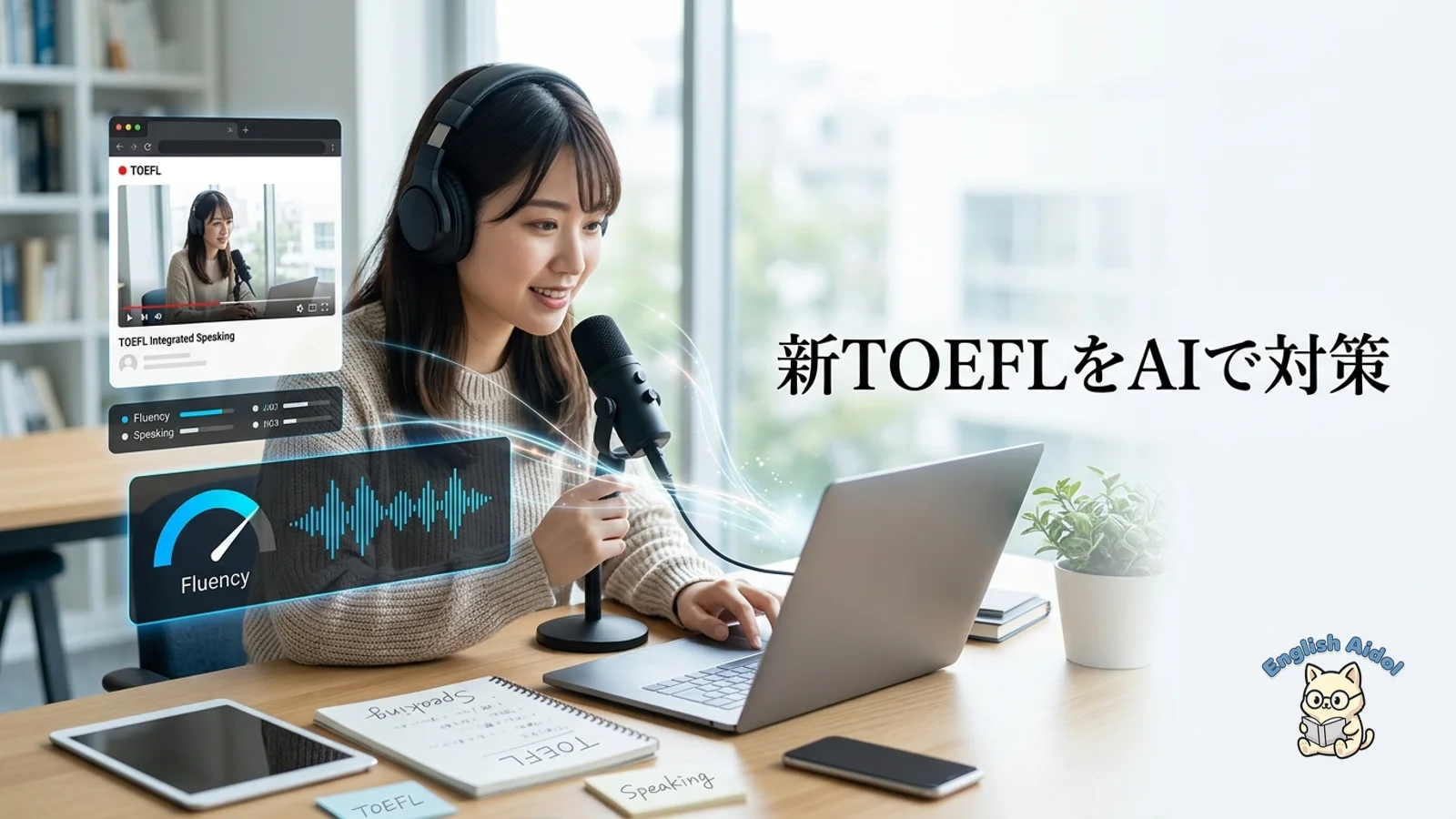
For Speaking practice, you record your response into your microphone. The AI transcribes your audio, measures speech rate and pause patterns to assess fluency, evaluates pronunciation clarity at the phoneme level, identifies grammatical errors, and scores vocabulary range. You receive a predicted band score within seconds, plus specific feedback: which words you mispronounced, where your grammar broke down, and which filler words ("um," "uh," "like") you used too often.
For Writing practice, you submit your essay. The AI evaluates it against four official criteria — Task Achievement, Coherence and Cohesion, Lexical Resource, and Grammatical Range and Accuracy — the same criteria human examiners use for IELTS Writing. It highlights specific sentences with weak vocabulary, suggests stronger alternatives, identifies grammar errors, and shows you where your argument structure could be tightened. The result is the kind of detailed feedback that traditionally cost $30–$80 per essay from a human tutor.
Why AI English Tutoring Beats Traditional Methods (For Most Skills)
Traditional English tutoring has three structural limits: it is expensive, it is rationed (you book sessions), and feedback arrives slowly. AI English tutoring removes all three. A typical IELTS tutor charges $30–$80 per hour. Daily practice with a human tutor costs $1,000–$2,400 per month — beyond reach for most candidates. With AI, the same daily practice volume is essentially free (or under $30/month for premium features). This cost difference matters because daily practice — not weekly tutor sessions — is what produces measurable band improvement.
The second advantage is feedback frequency. A human tutor reviews one essay per week, maybe two. An AI gives you instant feedback on every essay you submit — meaning you can write five essays in a single study session and see your improvements in real time. This rapid feedback loop is how skills actually develop. Practice without feedback teaches you to repeat the same mistakes; practice with instant feedback teaches you the correct pattern on every attempt.
The third advantage is consistency. Two different human tutors will score the same essay differently (human variance is real, which is why official IELTS uses double-marking). The same AI applies the same standards every time, so you can trust that progress over time reflects genuine skill improvement, not differences in who graded you.
Where Human Tutors Still Win
AI English tutoring is not strictly better than human tutoring. There are specific areas where a qualified human tutor adds value AI cannot replicate. Pragmatic and cultural feedback: a human tutor can tell you that your essay is grammatically correct but sounds odd because of cultural assumptions or register choices that an AI may not catch. Motivation and accountability: if you struggle to maintain daily practice alone, a weekly human tutor session creates the social commitment that pure self-study lacks. Complex conversation: AI Speaking practice is excellent for exam-style monologues (Part 2 cue cards) and Q&A (Parts 1 and 3), but free-flowing nuanced conversation with cultural context still favours a human partner.
The most cost-effective approach for most candidates is a hybrid: use AI for daily high-volume practice and feedback (5–10 sessions per week), and book a human tutor for one focused session per week to address specific weaknesses the AI flagged. This gives you the volume of AI practice with the depth of human review at roughly 20% of the cost of pure tutoring.
For candidates with very limited budget, AI-only preparation is now genuinely viable for reaching band 7+. Five years ago this was not true — AI scoring was not accurate enough. In 2026, the best AI English tutors give feedback that approaches human examiner quality on every dimension that matters for self-study improvement.
How to Get the Most from an AI English Tutor
Set a baseline. Before optimising your study, complete one full AI-graded mock test in each of the four skills — Reading, Listening, Writing, Speaking. Note your starting band in each. This baseline lets you measure real progress over the weeks ahead rather than guessing whether you are improving.
Focus on your weakest skill. Most candidates have one skill that is 1.0–1.5 bands below the others. AI practice on that skill will move your overall score faster than balanced practice across all four. If your overall is 6.0 but your Speaking is 5.5, daily AI Speaking practice is the highest-leverage use of your time.
Use AI feedback actively, not passively. Reading the feedback is not enough. After every AI-graded essay, rewrite the worst paragraph based on the AI suggestions. After every AI-graded speaking response, re-record the same answer applying the feedback. This rewrite step is what turns AI feedback into actual skill improvement.
Combine AI with authentic input. AI tutoring is excellent for output practice (Writing, Speaking) and instant scoring. It is not a replacement for input — you still need to read academic English daily and listen to native English audio for at least 30 minutes per day. The combination of authentic input and AI-graded output is what produces consistent band improvement.
Trust the trend, not single sessions. Your AI band score will fluctuate from session to session because AI scoring (like human scoring) has natural variance. Focus on the trend over 10+ sessions, not the result of any single one. If your trailing average is climbing, your skills are improving.
AI English Tutor for Specific Goals
For IELTS preparation: AI tutors are ideal because IELTS has well-defined band descriptors for Speaking and Writing. The AI evaluates against the same four criteria human examiners use — Fluency and Coherence, Lexical Resource, Grammatical Range and Accuracy, Pronunciation (Speaking) and Task Achievement, Coherence and Cohesion, Lexical Resource, Grammatical Range and Accuracy (Writing). Most candidates improve by 0.5–1.0 band within 4–8 weeks of daily AI practice.
For TOEFL iBT preparation: AI tutors are especially useful for the productive skills. Speaking feedback helps with Listen and Repeat accuracy, pronunciation, fluency, and interview answer development. Writing feedback helps with Build a Sentence accuracy, Write an Email tone, and Online Discussion responses that need a concise original contribution.
For TOEIC preparation: AI tutors specialise in the Listening and Reading sections, which are objective. The AI explains why each correct answer is correct, which question types you struggle with, and tracks your raw score progression toward your target (usually 700 for business roles, 850+ for international corporate positions).
For general English fluency: AI tutors offer free conversation practice on any topic, with feedback on grammar, vocabulary, and pronunciation. This is particularly useful for working professionals who want to improve business English, prepare for job interviews in English, or simply maintain their language skills.
What Makes a Quality AI English Tutor (Buyer's Guide)
The AI English tutor market is crowded with generic apps that claim AI features but actually offer little more than flashcards or grammar checkers. Look for these five markers when choosing a tool: (1) Criterion-level feedback — does the AI grade your Writing against the same four IELTS criteria a human examiner uses? Or does it just give a single overall score? (2) Speech analysis — does the Speaking AI actually evaluate your audio (transcription, fluency, pronunciation), or does it just transcribe your speech and grade the text? (3) Specific feedback — does the AI tell you which sentences had errors and what to do differently, or does it give generic tips like "improve your vocabulary"?
(4) Native language support — is the interface available in your first language (Korean, Japanese, Vietnamese, Indonesian, Arabic, Chinese)? Studying through your strong language while practicing your target language is significantly more effective than studying through a foreign interface. (5) Free practice volume — can you do meaningful practice (multiple full-length tests, multiple essays) before being asked to pay? Many "free" AI tutors give one demo and then paywall everything useful.
English AIdol meets all five criteria — full criterion-level feedback for IELTS, TOEFL, TOEIC, and PTE; phoneme-level pronunciation analysis for Speaking; specific sentence-by-sentence feedback for Writing; native-language interfaces in 12+ languages including Korean, Japanese, Vietnamese, Indonesian, Arabic, and Chinese; and genuinely free practice across all four skills with no aggressive paywall.
Frequently Asked Questions
What is an AI English tutor and how does it work?
An AI English tutor is software powered by artificial intelligence that teaches, assesses, and provides feedback on English skills. It uses speech recognition for pronunciation analysis, large language models for writing evaluation against specific criteria, and adaptive algorithms to personalise content to your level. The best AI tutors give criterion-level feedback that matches what human IELTS or TOEFL examiners provide.
Can an AI tutor help me improve my IELTS or TOEFL score?
Yes — most candidates improve their Speaking and Writing bands by 0.5–1.0 within 4–8 weeks of daily AI practice. AI provides feedback on the same four IELTS criteria human examiners use (Task Achievement, Coherence & Cohesion, Lexical Resource, Grammatical Range & Accuracy), and the same TOEFL criteria (Delivery, Language Use, Topic Development).
Is AI English tutoring better than a human tutor?
AI tutors excel at availability (24/7), consistency (same standards every time), instant feedback, and cost (essentially free vs $30–$80 per hour for human tutors). Human tutors excel at nuanced cultural feedback, motivation, and complex conversation. The most cost-effective approach combines daily AI practice with weekly human review.
Is there a free AI English tutor?
Yes — English AIdol provides genuinely free AI English tutoring across all four skills (Speaking, Writing, Reading, Listening) for IELTS, TOEFL, TOEIC, and PTE preparation. No credit card required for the basics. Available in Korean, Japanese, Vietnamese, Indonesian, Arabic, Chinese, and other native languages.
How accurate is AI English tutor scoring?
Modern AI English tutor scoring is within 0.5 band of human examiners on most submissions and within 1.0 band on essentially all submissions — comparable to the natural variance between two human examiners scoring the same response. The most accurate AI tutors are trained on tens of thousands of human-graded responses.
Which AI English tutor is best for Korean / Japanese / Vietnamese learners?
The best AI English tutor for non-English speakers offers a native-language interface, criterion-level feedback that matches the official exam scoring, and free practice volume. English AIdol supports interfaces in Korean (한국어), Japanese (日本語), Vietnamese (Tiếng Việt), Indonesian (Bahasa Indonesia), Arabic (العربية), Chinese (中文), and other languages — with country-specific tips for common pronunciation and grammar challenges.
How often should I practice with an AI English tutor?
For measurable improvement, practice 30–60 minutes per day, five days per week. The exact distribution depends on your weakest skill — focus 50–60% of practice time on your lowest-scoring skill, and the rest on maintaining your stronger skills. Quality of practice (with detailed feedback review) matters more than total hours.
Can AI tutors help with general English conversation, not just exams?
Yes — AI English tutors are excellent for general conversation practice, business English, job interview preparation, and academic discussion. They provide free unlimited conversation practice with feedback on grammar, vocabulary, and pronunciation, which is particularly useful for working professionals and students who want everyday English improvement beyond exam prep.