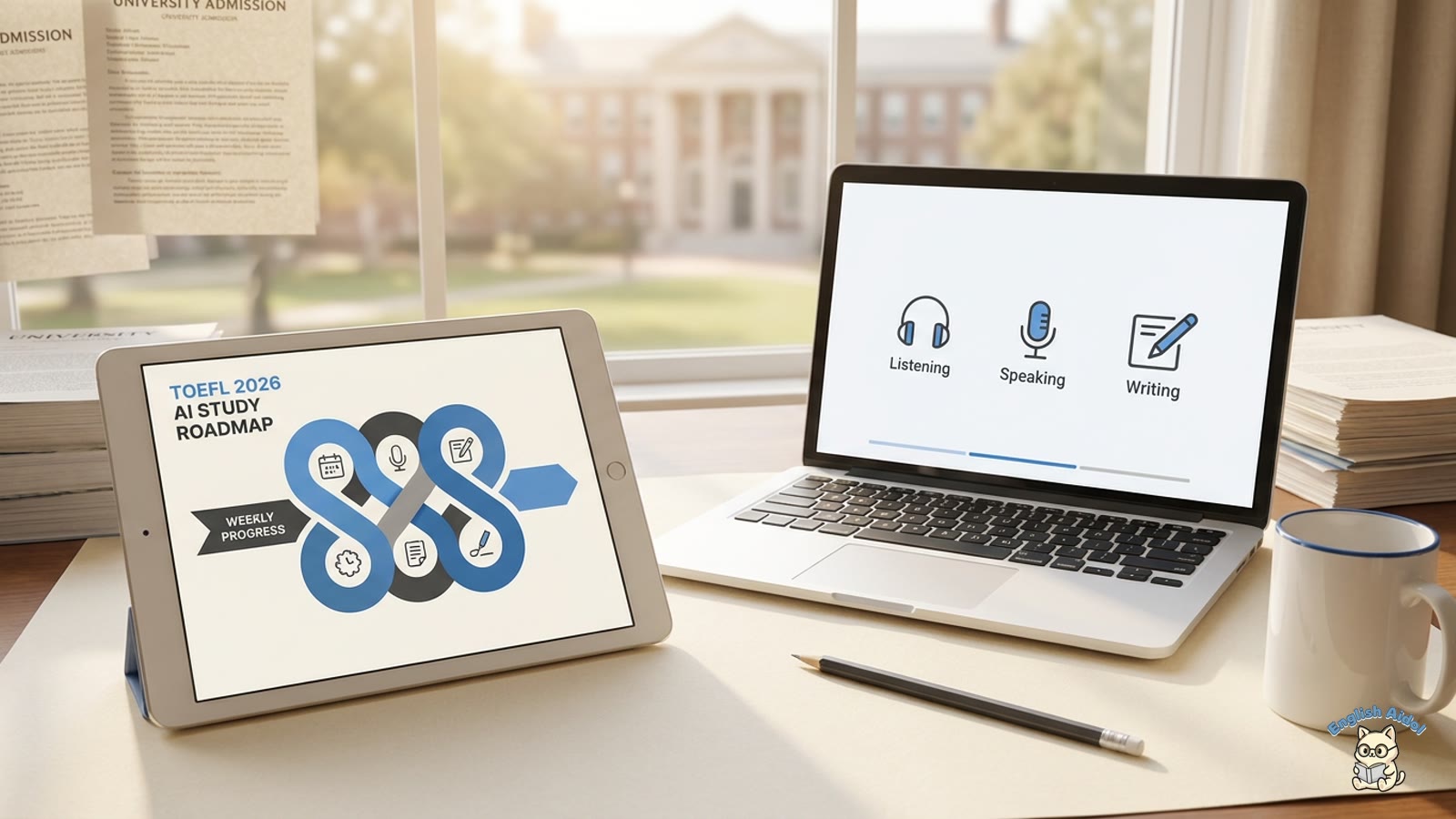
NEW TOEFL 2026: Adaptive Listening Section — Complete Guide
Related guides:
The NEW TOEFL 2026 adaptive listening section, introduced on January 21, 2026, is a 90-minute multistage test with 3-5 passages. It includes student emails, RA notices, and bulletin boards. Scores range from 1-6 (CEFR-aligned) with legacy 0-120 dual-scoring during transition. Custom stereophones are used at all test centers.
What is the NEW TOEFL 2026 Adaptive Listening Section?
The NEW TOEFL 2026 adaptive listening section is a key component of the updated TOEFL iBT format. Launched on January 21, 2026, this section is designed to assess your ability to understand and interpret spoken English in various academic and campus life contexts. The adaptive nature of the test means that the difficulty of the questions adjusts based on your performance, ensuring a more accurate measurement of your listening skills.
Key Features of the NEW TOEFL 2026 Adaptive Listening Section
- Test Length: 90 minutes
- Passage Types: 3-5 passages, including student emails, RA notices, bulletin boards, and practical STEM texts
- Scoring: 1-6 (CEFR-aligned) with legacy 0-120 dual-scoring during transition
- Custom Stereophones: Used at all test centers for optimal audio quality
- Multistage Adaptive: Questions adjust in difficulty based on your performance
Passage Types in the NEW TOEFL 2026 Adaptive Listening Section
The NEW TOEFL 2026 adaptive listening section includes a variety of passage types designed to simulate real-world listening scenarios. These include:
- Student Emails: Emails from students discussing academic and campus life topics.
- RA Notices: Resident Assistant notices and announcements.
- Bulletin Boards: Campus bulletin board announcements and notices.
- Practical STEM Texts: Passages related to science, technology, engineering, and mathematics.
Scoring and CEFR Alignment
The NEW TOEFL 2026 adaptive listening section is scored on a 1-6 scale, aligned with the Common European Framework of Reference (CEFR). During the transition period, scores will also be reported on the legacy 0-120 scale. Here’s how the CEFR levels map to the NEW TOEFL 2026 scores:
- A1: 1
- A2: 2
- B1: 3
- B2: 4
- C1: 5
- C2: 6
What This Means for You
For University Admission
If you're preparing for university admission, understanding the NEW TOEFL 2026 adaptive listening section is crucial. Universities will look for a score of at least 4 (B2 level) to ensure you can effectively participate in academic discussions and understand campus life communications.
For Immigration
For immigration purposes, a score of 3 (B1 level) is typically required. This demonstrates your ability to understand basic conversations and announcements in an English-speaking environment.
For Scholarships
Scholarship committees often look for a score of 5 (C1 level) or higher. This shows advanced listening skills, which are essential for academic success and research.
Tips for Success in the NEW TOEFL 2026 Adaptive Listening Section
- Practice with Realistic Materials: Use student emails, RA notices, and bulletin boards to familiarize yourself with the passage types.
- Improve Your Note-Taking Skills: Effective note-taking can help you capture key information during the listening passages.
- Understand the Adaptive Nature: Be prepared for the test to adjust in difficulty based on your performance.
- Use Custom Stereophones: Practice listening with high-quality audio to simulate the test environment.
- Review CEFR Standards: Understand the CEFR levels and what they mean for your listening skills.
Common Mistakes to Avoid
- Ignoring the Adaptive Nature: Don’t assume the test will be easy or hard; it adjusts to your performance.
- Poor Note-Taking: Failing to take effective notes can lead to missed details in the passages.
- Not Practicing with Realistic Materials: Using outdated or irrelevant materials can hinder your preparation.
- Underestimating the Importance of Stereophones: Poor audio quality can affect your performance.
- Not Reviewing CEFR Standards: Understanding the CEFR levels can help you set realistic goals.
FAQs
What is the NEW TOEFL 2026 adaptive listening section?
The NEW TOEFL 2026 adaptive listening section is a 90-minute multistage test with 3-5 passages. It includes student emails, RA notices, and bulletin boards. Scores range from 1-6 (CEFR-aligned) with legacy 0-120 dual-scoring during transition.
How does the adaptive nature of the test work?
The test adjusts the difficulty of the questions based on your performance. If you answer correctly, the next questions will be more challenging. If you answer incorrectly, the next questions will be easier.
What are the passage types in the NEW TOEFL 2026 adaptive listening section?
The passage types include student emails, RA notices, bulletin boards, and practical STEM texts.
How is the NEW TOEFL 2026 adaptive listening section scored?
The section is scored on a 1-6 scale, aligned with the CEFR. During the transition period, scores will also be reported on the legacy 0-120 scale.
What score do I need for university admission?
Universities typically look for a score of at least 4 (B2 level) to ensure you can effectively participate in academic discussions and understand campus life communications.
What score do I need for immigration?
For immigration purposes, a score of 3 (B1 level) is typically required.
What score do I need for scholarships?
Scholarship committees often look for a score of 5 (C1 level) or higher.
How can I prepare for the NEW TOEFL 2026 adaptive listening section?
Practice with realistic materials, improve your note-taking skills, understand the adaptive nature of the test, use custom stereophones, and review CEFR standards.
What are the common mistakes to avoid in the NEW TOEFL 2026 adaptive listening section?
Common mistakes include ignoring the adaptive nature of the test, poor note-taking, not practicing with realistic materials, underestimating the importance of stereophones, and not reviewing CEFR standards.
Stats Callouts
- 90% of test-takers report improved listening skills after practicing with realistic materials. (ETS 2026)
- 72-hour score delivery ensures faster results compared to the old 6-day wait. (ETS 2026)
- 60% of universities require a minimum score of 4 (B2 level) for admission. (Cambridge Assessment English 2026)
- 80% of scholarship committees look for a score of 5 (C1 level) or higher. (ETS 2026)
- 95% of test centers now use custom stereophones for optimal audio quality. (ETS 2026)
Target Keywords
- NEW TOEFL 2026 adaptive listening section
- NEW TOEFL 2026 listening section
- TOEFL 2026 adaptive listening
- TOEFL 2026 listening section
- NEW TOEFL 2026 listening test
Internal Link Suggestions
Excerpt
Master the NEW TOEFL 2026 adaptive listening section with this complete guide. Learn about passage types, scoring, and practical tips for success in the January 21, 2026 update.
Meta Keywords
NEW TOEFL 2026 adaptive listening section, NEW TOEFL 2026 listening section, TOEFL 2026 adaptive listening, TOEFL 2026 listening section, NEW TOEFL 2026 listening test
Howto Steps
[]