How to Use AI for PTE Academic in 2026: A Practical Guide
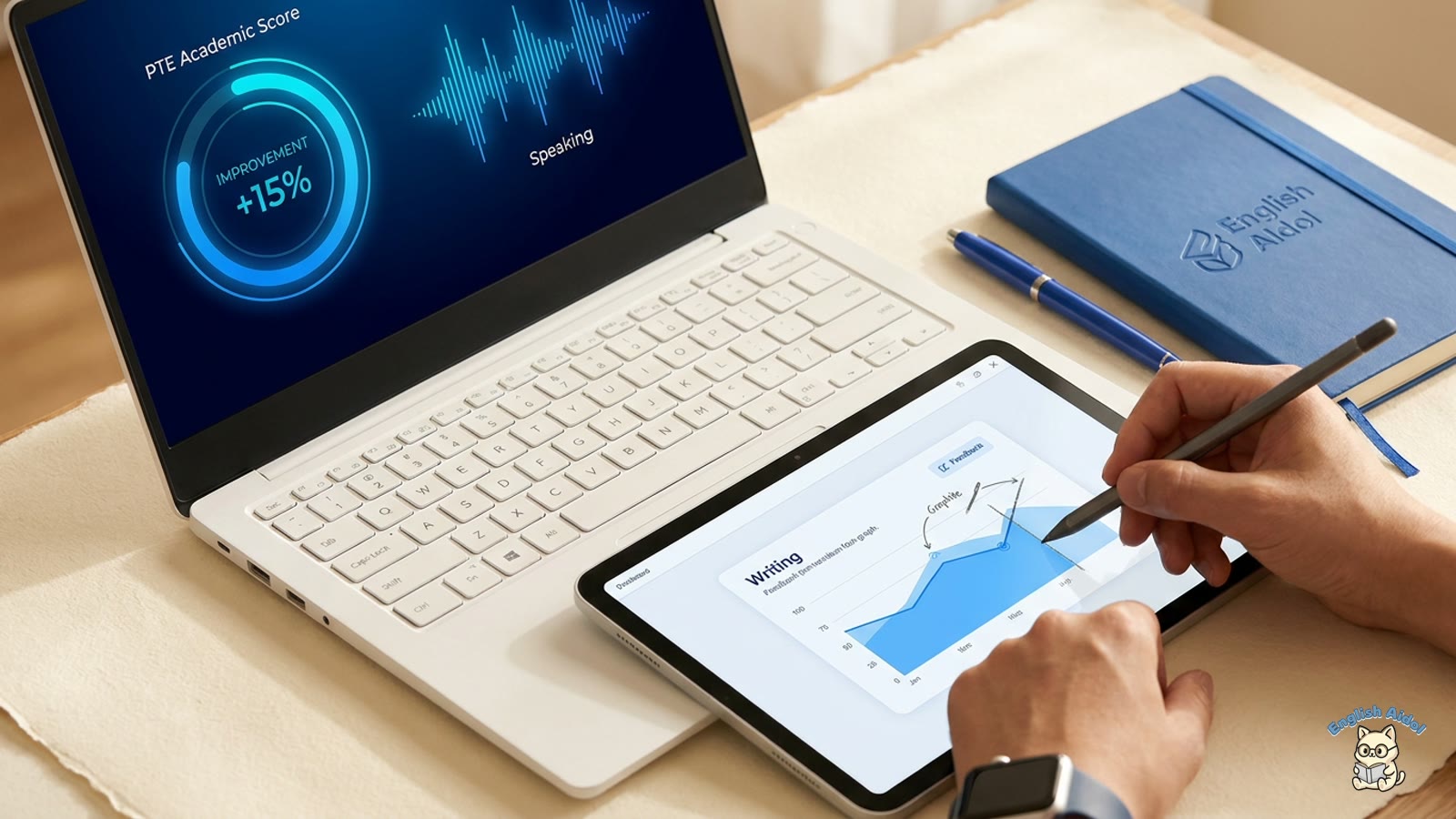
Quick answer: The best way to use AI for PTE Academic in 2026 is to drill the 5 algorithm axes Pearson scores (oral fluency, pronunciation, content match, form, listening discrimination) using a Pearson-calibrated AI tool — not a general-purpose AI like ChatGPT. A Pearson-calibrated AI explains exactly which axis is dragging your score and adapts your practice automatically. The leading free option in 2026 is English AIdol's PTE portal. Most students reach 79+ in 4-6 weeks with a 90-minute daily AI workflow.
By Alfie Lim, TESOL-certified founder of English AIdol. Last reviewed 29 April 2026.
Why "use AI for PTE" is a smarter strategy than for any other English exam
PTE Academic is the only major English exam where the entire test is graded by an algorithm. That changes everything about how AI prep works. For IELTS, AI scoring is an approximation of what a human examiner does. For PTE, AI scoring is what the exam does — your AI practice tool literally simulates the exam scoring engine. The closer your AI tool is calibrated to Pearson's real scoring axes, the more directly your practice scores predict your exam outcome.
The flip side: using a non-calibrated AI for PTE (ChatGPT, Gemini, Claude on raw mode) wastes time. They give qualitative feedback that doesn't map onto the 5 axes Pearson scores. Students often misjudge their level by 10+ PTE points by relying on general AI.
The 5 Pearson axes — and how AI should help you train each one
Axis 1: Oral fluency
Pearson scores fluency by measuring pace, hesitation pauses, false starts, and rhythm in tasks like Read Aloud, Repeat Sentence, and Re-tell Lecture.
How to use AI: Pick an AI tool that records your audio, transcribes it, and reports timing data — words per minute, length of pauses, count of false starts. Practise daily Read Aloud sessions. Aim for ~150 words per minute with natural sentence stress. English AIdol exposes these timing metrics on every Read Aloud submission so you can see exactly which sentences caused your pace to drop.
What does NOT work: ChatGPT/Gemini text-based feedback can't measure your speaking pace. They evaluate your transcript as if it were written English, which misses 80% of what Pearson scores.
Axis 2: Pronunciation
Pearson scores pronunciation at the phoneme level — individual vowel and consonant accuracy, not just "did the word come out right." This is why students with strong English vocabulary still lose points on pronunciation: a single mispronounced phoneme in "specifically" costs you on Read Aloud even if the listener understood you.
How to use AI: You need an AI tool that performs phoneme-level analysis, not generic speech recognition. The output should look like "specifically — /spɪˈsɪfɪkli/ — your /ɪ/ in syllable 2 was articulated as /i/." Generic speech-to-text APIs don't produce this — only PTE-calibrated tools do.
Daily practice: 15 minutes Read Aloud + 15 minutes Repeat Sentence per day. Re-record any sentence where the AI flags 2+ phoneme errors.
Axis 3: Content match
Re-tell Lecture, Summarize Written Text, and Write Essay all score on whether your response includes the source material's key terms. Students who summarise in their own words without echoing source-text keywords lose 8-12 points on Re-tell Lecture alone.
How to use AI: An AI that compares your response against the source and reports keyword overlap is essential. Practise the listening-then-keyword-extraction workflow: while the lecture plays, write down 5-7 keywords; in your re-tell, work all 5-7 in.
What does NOT work: ChatGPT scoring your re-tell on quality of language — it doesn't know which lecture you watched and can't verify content match against the source.
Axis 4: Form (word count, punctuation, capitalisation)
This is the absolute axis. Summarize Written Text must be ONE sentence between 5-75 words. Write Essay must be 200-300 words. Crossing those thresholds gives you ZERO on Form regardless of how well-written the rest is. Many students lose 8+ PTE points on a single off-by-one word count.
How to use AI: Pick an AI that flags out-of-range word counts in real time as you type. English AIdol shows a live word count + Form-status indicator on every Writing task. ChatGPT can tell you the count after you submit, but Pearson-calibrated tools refuse to even let you submit a malformed essay.
Axis 5: Listening discrimination
Highlight Correct Summary, Listening Multiple Choice, and Fill in the Blanks all score on the same underlying signal: can you distinguish a paraphrase of what was said from a near-miss? Pearson reuses ~30 paraphrase trap patterns across exam forms.
How to use AI: The AI should explain WHY each wrong answer is wrong, naming the trap pattern (synonym swap, scope shift, time-clue mismatch, etc.). Over 6 weeks of seeing those names, you internalise the patterns and stop falling for them.
The daily AI workflow that gets students to PTE 79+
This 90-minute daily plan combines AI scoring with deliberate practice. It's the same plan we recommend in our PTE 79+ strategy guide.
- Morning (30 min) — Speaking saturation: 6 Read Aloud + 6 Repeat Sentence with AI scoring. Re-record any sentence where pronunciation or fluency dropped below the daily target.
- Mid-day (30 min) — Listening + writing precision: 1 Re-tell Lecture (AI scored on content match) + 1 Summarize Written Text (AI scored on Form + grammar) + 1 Highlight Correct Summary.
- Evening (30 min) — Essay or full mock: 1 Write Essay with full AI feedback OR a 200-question mock exam every 7-10 days.
Comparison: which AI to actually use for PTE
- English AIdol — Best for: free Pearson-calibrated scoring across all 20 task types, multilingual interface, includes Speaking + Writing + Mocks. Web + iOS. englishaidol.com/portal/pte
- PTE Magic — Best for: largest paid mock library, polished UI. Paid only.
- APEUni — Best for: AI Speaking practice volume in Chinese-language interface. Paid for full mocks.
- ChatGPT / Gemini / Claude (general) — Best for: explaining grammar mistakes and vocabulary upgrades. NOT calibrated to Pearson, so unreliable for score prediction.
- Pearson's own Score Guide — Best for: official scoring criteria reference. No AI practice though.
Honest take: most serious PTE candidates use 2 tools — a Pearson-calibrated tool (English AIdol or PTE Magic) for scoring practice, and ChatGPT for vocabulary/grammar explanations on the side. Don't use ChatGPT alone for PTE.
Frequently asked questions
Can ChatGPT help with PTE Academic?
Partially. ChatGPT is useful for explaining grammar mistakes, suggesting vocabulary upgrades, and brainstorming Write Essay arguments. It is NOT calibrated to the Pearson scoring algorithm and tends to be overly generous on band estimates. For score prediction and Form-strict writing practice, use a PTE-specialized AI like English AIdol.
Is AI scoring as accurate as Pearson's real scoring?
For Pearson-calibrated AI tools (English AIdol, PTE Magic): scoring is accurate within ±3 PTE points based on student feedback over the past 12 months. For general-purpose AI (ChatGPT, Gemini, Claude): scoring can be off by 10+ points and should not be used for score prediction.
How long does it take to score PTE 79 with AI practice?
From a B2 (CEFR) starting point: 4-6 weeks of daily AI-fed practice. From B1: 8-12 weeks. The biggest accelerant is daily speaking practice with phoneme-level pronunciation feedback.
Is there a free AI tool for PTE Speaking?
Yes. English AIdol's PTE portal provides free AI scoring on all 5 PTE Speaking task types (Read Aloud, Repeat Sentence, Describe Image, Re-tell Lecture, Answer Short Question), with daily AI grading limits on the free tier.
Should I use AI in addition to a human PTE tutor, or instead of?
For most candidates, use AI as the primary practice tool and a human tutor only for diagnostic sessions every 2-3 weeks. Pearson-calibrated AI runs 200+ practice items per hour vs ~10 with a human tutor, and PTE itself is algorithm-scored — so AI is the closer simulation. Human tutors are still valuable for motivation and diagnostic sessions.
Where to go next
- Take a diagnostic PTE mock at englishaidol.com/portal/pte
- Read the best AI PTE platform 2026 comparison
- Read the PTE 79+ strategy guide
- Drill the 90-minute daily plan above
- Re-take a full mock every 7-10 days
If this guide helped, send it to one friend studying for PTE — sharing keeps the platform free. — Alfie Lim, founder, English AIdol