A repeatable way to choose an IELTS AI tool
“Best” is useful only when the comparison explains best for whom, tests the same inputs, and discloses conflicts. Start with official IELTS materials for the live format and scoring criteria. Then compare independent tools on the feedback they provide for your own response.
Download the open IELTS AI evaluation rubric (CSV). It contains the criteria, weights, evidence requirements, and automatic fail conditions used by this guide. You may reuse the blank rubric with attribution.
The eight criteria in the scorecard
- Feedback evidence (20%). Does the tool point to specific words, sentences, or moments in the learner's response?
- Official-criteria traceability (15%). Can a learner connect the comment to current published IELTS criteria without implying endorsement?
- Format fidelity (15%). Are task type, instructions, and timing checked against current official information?
- Scoring transparency (15%). Are estimates labelled unofficial, with validation evidence and uncertainty stated rather than implied?
- Practice breadth (10%). Does the tool support the skill and task the learner actually needs?
- Language and accessibility (10%). Can the learner understand and act on the feedback?
- Privacy and control (10%). Are audio, text, retention, deletion, and model-training terms findable?
- Price and limits (5%). Are the current plan, usage limits, renewal terms, and cancellation path clear?
How English AIdol should be evaluated
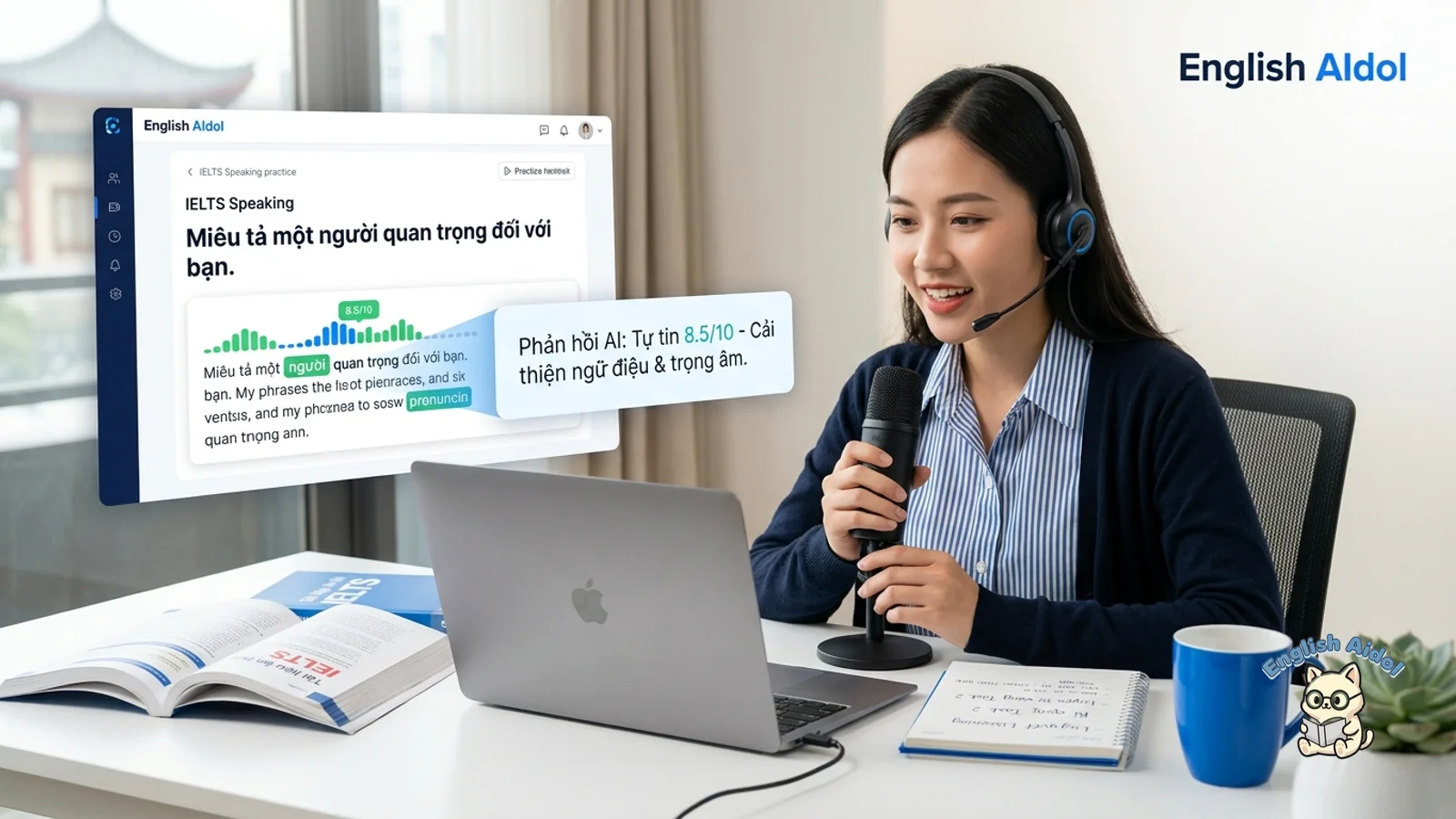
English AIdol offers independent practice across IELTS Reading, Listening, Writing, and Speaking, including AI-generated feedback for some responses. Its estimates are not official results. English AIdol has not published an independent validation study showing a fixed agreement rate with trained examiners, so the scoring-transparency criterion must reflect that limitation.
Feature availability, usage limits, and prices can change. Check the live product and pricing pages on the day of comparison. English AIdol is the publisher of this guide, so this page should not be treated as an independent endorsement.
A fair five-step comparison
- Choose one current task and prepare one unchanged response.
- Test each tool on the same date and record the exact product and plan.
- Save the comments and score each criterion only when evidence is visible.
- Revise one weakness and check whether the next feedback responds to the change.
- Publish the completed scorecard, conflicts, and limitations if you share a ranking.
Do not convert a few examples into a universal accuracy claim. A credible accuracy result needs a described sample, qualified human rating process, uncertainty analysis, and independent review.
Fill in the worksheet: method version 1.0
This is a subjective product-comparison framework. English AIdol selected the weights and the 0–4 anchors. It is not a validated exam-scoring instrument, an accuracy percentage, an IELTS band conversion, or evidence that a product improves scores.
Download the blank evaluation worksheet (CSV) and download method version 1.0 (JSON, 22 September 2026). Use the original rubric beside the worksheet to select an anchor.
- Record the product, plan, date, task and unchanged response identifier. Keep the same inputs and comparable conditions for every product.
- For each criterion, save evidence and explain the chosen integer score from 0 to 4. Record reviewer status, commercial interests and limitations.
- Calculate criterion points = weight × score ÷ 4. For example, a score of 3 on the 20% feedback-evidence criterion contributes 15 points. This is arithmetic, not a score awarded to any product.
- Leave missing evidence as unknown with a blank score and points. Missing evidence is not zero; zero is reserved for a supported zero-anchor finding. Do not impute missing scores or renormalize weights.
- Only total the points when all eight criteria have evidence-backed scores. The complete total is out of 100 and expresses this framework's preferences, not scientific measurement.
- Record each automatic-fail condition as yes, no or unknown, with evidence. A yes prevents a positive overall recommendation under this framework regardless of the total. Unknown is unresolved, not a pass. A complete score alone is not a recommendation.
Report only review actually completed: self-assessment, automated review, or qualified human review where performed. A source check is not product validation, and AI review is not human expert review.
Prepared with AI assistance and published by English AIdol. No human expert review is claimed. Page updated 22 September 2026.
Frequently Asked Questions
What is the best AI for IELTS preparation?
There is no universal winner. The best fit depends on your weakest skill, budget, language needs, privacy preferences, and whether the feedback shows evidence from your response. Use the downloadable rubric on this page to compare tools on the same work sample.
Does English AIdol provide official IELTS scores?
No. English AIdol provides independent practice and AI-generated estimates. They are not official IELTS results and have not been independently validated as equivalent to examiner-awarded bands.
Can an AI IELTS tool replace a teacher or examiner?
An AI tool can make repeated practice and revision easier, but it can miss context, interaction, and nuanced judgement. Use qualified human review when an unresolved problem or high-stakes deadline warrants it. Only the official test can issue an IELTS result.
How should I compare AI IELTS tools?
Submit the same response, record the date and plan tested, score the evidence and limitations rather than the marketing, then revise one weakness and test again. Check current official IELTS information separately.
Why does English AIdol publish a blank scorecard instead of ranking itself first?
English AIdol has a commercial interest in the comparison. Publishing the criteria, weights, limitations, and blank scorecard lets learners and independent reviewers reproduce the comparison instead of relying on a self-awarded title.